Which Scales Are Used in Psoriasis Clinical Trials?
Source: EClinCloud. Author: EClinCloud.

Psoriasis (PS) is an immune-mediated, chronic, relapsing, inflammatory, systemic skin disease triggered by the combined effects of genetic and environmental factors. Its typical clinical manifestations are scaly erythema or plaques with localized or widespread distribution. It is non-contagious, difficult to treat, and often lifelong. Psoriasis can occur at any age with similar prevalence in men and women; approximately 2/3 of patients develop the disease before age 40, and most patients tend to relapse or worsen in winter and improve in summer.
Classification and Severity Grading of Psoriasis
The main subtypes of psoriasis include psoriasis vulgaris, pustular psoriasis, erythrodermic psoriasis, and arthropathic psoriasis. Among these, plaque psoriasis within psoriasis vulgaris is the most common, accounting for approximately 80–90% of psoriasis cases. Based on disease progression, psoriasis can be divided into progressive, stationary, and regressive stages.
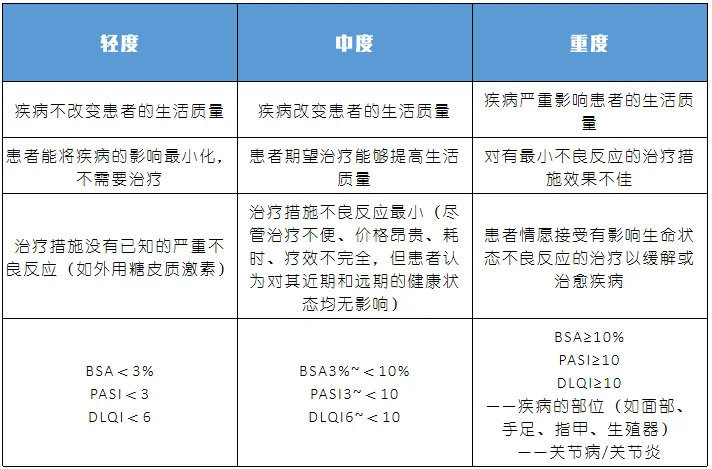
Before formulating an appropriate treatment plan, it is necessary to assess the severity of psoriasis, including the extent and location of involvement, the severity of skin lesions, and the impact on quality of life. In the Chinese Guidelines for the Diagnosis and Treatment of Psoriasis (2018), disease severity is graded based on scale scores; the specific simplified clinical method for defining psoriasis severity grades is as follows:
Note: BSA, Body Surface Area; PASI, Psoriasis Area and Severity Index; DLQI, Dermatology Life Quality Index
Selection of Psoriasis Scales
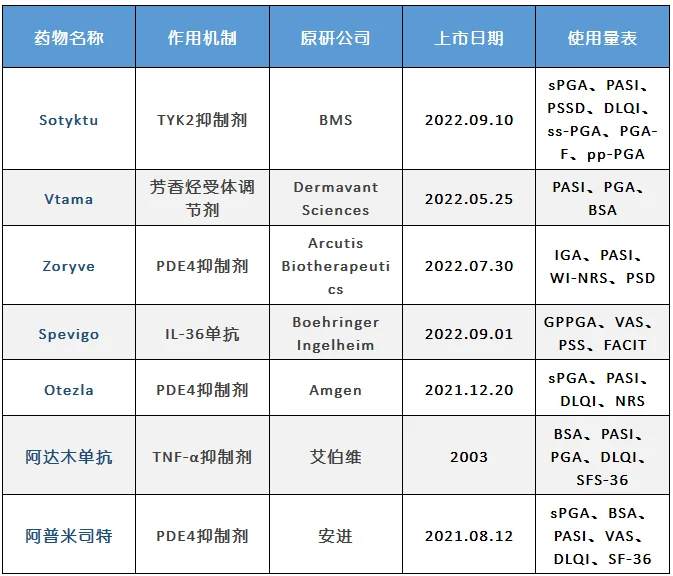
Because of its distinctive characteristics—relapsing nature, incurability, skin damage, and accompanying pruritus—psoriasis (PS) affects patients' physical and mental health as well as their social life to varying degrees. Therefore, the application of clinical outcome assessment (COA) data is critical, and scales have become important measures for evaluating objective drug efficacy outcomes in clinical trials. Below is a summary of the scales used for selected psoriasis drugs approved by the FDA and NMPA in recent years:
EClinCloud has extensive experience in clinical research eCOA projects, with both a vast scale library and an experienced expert team providing one-stop scale services for sponsors and CROs. EClinCloud also has some project experience in dermatology and provides a brief overview and comparative analysis of the intended purpose, type, main content, and advantages and disadvantages of scales used in psoriasis (PS) clinical trials.
Psoriasis-Specific Scales
Body Surface Area (BSA) Score.
Purpose
To estimate the overall skin lesion area of psoriasis
Main Content
— Uses the "Rule of Nines" to estimate adult body surface area by hand: head and neck account for 9%, upper limbs for 18% (2 × 9%), lower limbs for 36% (4 × 9%), and trunk for 37% (4 × 9% + genitalia 1%), totaling 11 increments of 9% and 1 increment of 1%, or 100%.
— Estimates the area of one palm as 1% of total body surface area (i.e., BSA ≈ 1%), using this method to estimate the area of skin lesions and further assess disease severity.
Limitations
BSA is relatively subjective and prone to overestimation; the widely accepted value that one palm accounts for 1% of body surface area is inaccurate, as it is affected by factors such as age, sex, race, and body mass index.
Note
BSA is not a scale, but rather a scoring standard. For patients with fewer and more localized lesions, direct measurement using the palm area method is recommended; for patients with more widespread lesions, central post-regression hyperpigmented patches, or annular lesions, the "Rule of Nines" is recommended.
Psoriasis Area and Severity Index (PASI).
Purpose
Assesses the severity of psoriasis and disease progression during treatment
Overview
Lesion area: The body is divided into 4 regions—head and neck, upper extremities, lower extremities, and trunk—each assigned an area score; each of the 4 regions is scored from 0 to 6 based on the percentage of affected skin area.
Lesion severity: Three dimensions—erythema (E), induration (I), and scaling (S)—are scored separately from 0 to 4 points each, and their sum gives the lesion severity score.
Limitations
Assessment by a trained rater takes approximately 15 minutes, which is time-consuming and unsuitable for large-scale epidemiological surveys; it is also heavily influenced by rater subjectivity, which can lead to wide variability in psoriasis area estimates.
Note
This scale is recommended by the FDA and EMA as an evaluation measure for disease severity and drug efficacy in patients with psoriasis, and is regarded as the "gold standard" for assessing psoriasis severity. Chinese guidelines for the diagnosis and treatment of psoriasis recommend that an effective response to biologic therapy in plaque psoriasis vulgaris be defined as a 75% improvement in PASI score (∆PASI).
Psoriasis Static Physician's Global Assessment (sPGA).
Purpose
Assesses overall psoriasis lesions at a single point in time
Overview
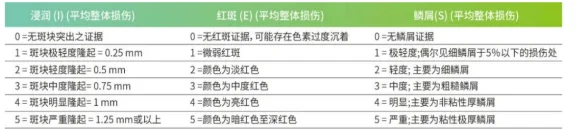
Induration (I), erythema (E), and scaling (S) are rated according to the table below, and the sum of the three scores is divided by 3 to obtain the final PGA score.
Limitations
Measures psoriasis severity at only a single time point and cannot assess overall dynamic improvement in disease from baseline.
Advantages
Both sPGA and PASI are commonly used in clinical trials to measure psoriasis severity; the consistency and reliability of sPGA are unaffected by the physician's level of experience, and its assessment of disease severity is more intuitive than that of PASI.
Note
The sPGA has many different versions, using different scoring scales such as 5-point, 6-point, and 7-point scales.
Dermatology-Specific Scales
Dermatology Life Quality Index (DLQI).
Purpose
Widely used to evaluate the severity of various skin diseases
Overview
Consists of 10 items across 6 domains: symptoms and feelings, daily activities, leisure, work and school, personal relationships, and treatment.
Limitations
Cannot be subdivided into separate dimensions and is limited to a total score; in practice, it is often used in combination with other scales.
Advantages
Can be used to evaluate the degree of disease change before and after psoriasis intervention, and is currently the most commonly used measure in China and internationally for assessing quality of life and drug efficacy in patients with psoriasis.
Note
License access for this scale is free for non-commercial research use; derived versions include the Family Dermatology Life Quality Index (FDLQI) and the Children's Dermatology Life Quality Index (CDLQI), with the CDLQI designed for children aged 4 to 16 years and featuring cartoon illustrations for easy acceptance by children.
Generic Scales
Short Form Health Survey (SF-36).

Purpose
Assesses general health concepts related to age, disease, and treatment
Overview
Includes 11 items and 36 related questions covering 8 dimensions: physical functioning, role-physical, bodily pain, general health, vitality, social functioning, role-emotional, and mental health.
Limitations
Focuses primarily on physical disability and impairment in psoriasis while giving insufficient attention to issues such as stigma and embarrassment, and lacks sensitivity to differences between treatment and placebo groups in clinical trials.
Note
There are 2 versions of this scale with different copyright holders; the version commonly used today is version 2.0, revised in 1998. The copyright holder of version 2.0 provides Chinese-language versions of the scale, rater training materials, and related resources.
Sickness Impact Profile (SIP).
Purpose
Provides a detailed account of changes in an individual's behavior caused by illness
Main Content
It comprises 12 categories—specifically physical, psychosocial, and other dimensions—with a total of 136 items.
Limitations
Because it contains a large number of items and takes a long time to administer—approximately 40 minutes to complete—it is not easy to use widely in clinical practice.
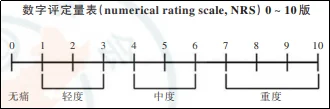
Worst Itch Numerical Rating Scale (WI-NRS).
Purpose
Assesses the severity of a patient's worst itch over the past 24 hours.
Main Content
Graded based on the patient's own itch severity:
Limitations
Because it is highly subjective and patients vary in how they interpret itch severity, its reproducibility is relatively poor. It requires the ability to understand an abstract scale as well as a certain level of reading comprehension, so it is suitable for literate patients aged 10 years and older.
Advantages
It uses a concise, intuitive numerical rating and can also be administered via verbal interview (such as by telephone), making it widely used in clinical practice and scientific research.
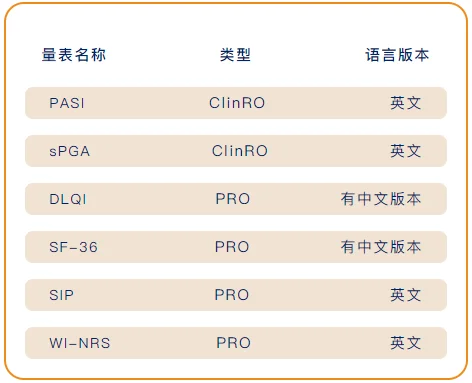
Summary and Comparison of Scales:
In addition to these standard psoriasis scales, there are scales for other subtypes or specific anatomical sites, such as the Psoriatic Arthritis Quality of Life (PsAQoL) scale for psoriatic arthritis; the Psoriasis Scalp Severity Index (PSSI) and Scalp-modified Psoriasis Area and Severity Index (S-mPASI) for scalp psoriasis; and the Nail Assessment in Psoriasis and Psoriatic Arthritis (NAPPA) for nail psoriasis. We will not elaborate further on these here; please feel free to contact us if you have specific requirements.

References
[1] Zhang Xuejun. Guideline for the Diagnosis and Treatment of Psoriasis in China (2018 Complete Edition). Chinese Journal of Dermatology, 2019,52(10):667-710.
[2] Feng Li, Liu Qiongling. Research status of quality of life scales for patients with psoriasis. Chinese Nursing Research (Mid-Monthly Edition), 2015,29(3):900-903.
[3] Ellis CN, Mordin MM, Adler EY, et al. Effects of alefacept on health-related quality of life in patients with psoriasis: Results from a randomized, placebo-controlled phase II trial. American Journal of Clinical Dermatology, 2003,4(2):131-139.
[4] Zhang Xiaoya, Yang Jiao, Xu Chenchen, Qu Shengyuan, Cui Bingnan. Current status and progress of evaluation scales for scalp psoriasis. The Chinese Journal of Dermatovenereology, 2022,36(10):1210-1215.
[5] Wan Li, Zhao Qing, Chen Jun, et al. Chinese expert consensus on the application of pain assessment scales (2020 edition). Chinese Journal of Painology, 2020,16(3):177-187.
[6] Wang Xiaoling, Zhao Tian'en, Zhang Xiqin. Preliminary study on the reliability and validity of the Simplified Chinese version of the Dermatology Life Quality Index. Chinese Journal of Epidemiology, 2004,25(9):791-793.
EClinCloud is a technology company focused on clinical research and development. It provides an integrated, interconnected, unified clinical trial cloud platform (including technology products such as CTMS, eTMF, EDC, RTSM, eCOA, and eConsent, and solutions such as scale management, linguistic validation, rater training, and data quality analysis) as well as clinical trial endpoint assessment technologies across therapeutic areas (including oncology, central nervous system, ophthalmology, and others). Combining cutting-edge technology with life data to build a globally leading, "patient-centric" SaaS cloud platform for clinical evidence support, it helps domestic and international pharmaceutical companies and research institutions improve R&D efficiency, accelerate the market launch of drugs/devices, and benefit countless patients.