How Is Pain Assessed? Quick Tips for Choosing a Scale

Source: EClinCloud. Author: EClinCloud.

As the population ages, the number of patients experiencing pain has surged. The physical and psychological distress and fear brought on by pain also greatly affect people's quality of life, creating a growing need for pain prevention, treatment, and control.

Patient
Doctor, my leg has been hurting a lot these past couple of days. Could you take a look and tell me what's going on and how it should be treated?

What does the pain feel like? How severe is it, and is it affecting your daily life?
Patient
Um... I'm not really sure how to describe it. It just hurts a lot when I walk for a long time or run...
Does this sound just like a real conversation with a doctor?
Pain is a subjective experience influenced by many factors, including a patient's physiological and psychological state, personal history, and sociocultural background. Individuals also differ in how they understand and perceive pain. Patients therefore need to express and assess their pain accurately so that physicians can better diagnose and treat it.


Expert Commentary
Pain intensity and pain quality are considered primary factors affecting a patient's overall function and sense of well-being, and are generally assessed across multiple dimensions using self-report scales, behavioral tests, and physiological measurements.
With brief training from healthcare providers, patients can complete self-assessments, which is very important for self-monitoring pain. Therefore, self-report scales are considered the gold standard for pain assessment.
What are some commonly used scales? Let's take a look.
Pain Intensity Assessment
By using numbers, words, images, and similar formats, unidimensional pain assessment scales allow patients to express subjective pain sensations objectively and evaluate pain intensity along a single dimension. Because they are quick to administer, concise, and easy for patients to understand, unidimensional pain scales are commonly used for rapid clinical diagnosis and treatment.
01
Visual Analog Scale (VAS)
Overview:
Consists of a 100 mm line, with one end representing "no pain" and the other representing "most severe pain."
Advantages:
Accurate, simple to administer, and highly sensitive. Because its values vary continuously, it not only better reflects subtle changes in pain, but can also be analyzed using parametric statistical tests.
Limitations:
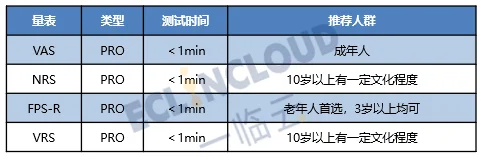
The VAS requires patients to have a certain level of abstract thinking ability and is therefore recommended for adult patients.

02
Numeric Rating Scale (NRS)
Overview:
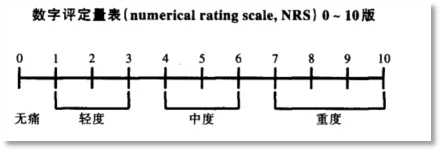
Uses numbers from 0 to 10 to represent pain intensity, categorized into 4 levels: no pain (0), mild pain (1–3), moderate pain (4–6), and severe pain (7–10).
Advantages:
The categories are relatively clear and objective, helping patients make more accurate assessments and improving comparability across different patients.
In addition, the NRS can be administered verbally (such as in telephone interviews).
Limitations:
Requires patients to have the ability to understand abstract scales as well as a certain level of reading comprehension; it is therefore recommended for patients aged 10 and older with a basic level of education, with further explanation provided by study staff when necessary.
The NRS has relatively poor repeatability, so it should be selected with caution when conducting longitudinal follow-up trials. Its ability to reflect differences in small changes is inferior to that of the VAS.
03
Revised Wong-Baker Faces Pain Scale (FPS-R)
Overview:
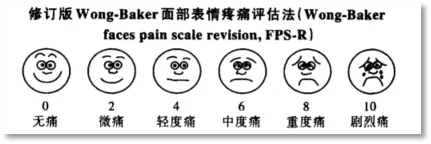
Uses 6 different facial expressions ranging from "smiling" to "crying" to visually express the pain intensity represented by each score range.
Advantages:
Relatively intuitive and easy to understand, making it better suited for children aged 3 years and older, older adults, and patients with lower educational attainment; it can even be used in patients with communication difficulties, impaired consciousness, or cognitive impairment.
Limitations:
Patients need to carefully observe and distinguish the cartoon facial expressions before assessment. Because patients perceive the level of pain represented by each facial expression differently, test results can also be influenced by cultural and other confounding factors. Therefore, it may be unfavorable for comparative studies before and after treatment, across different patients, or across cultures. Its ability to reflect differences in small pain changes is inferior to that of the VAS.
04
Verbal Rating Scale (VRS)
Overview:
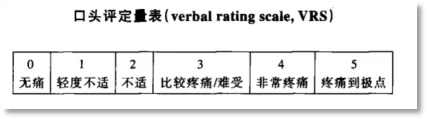
Part of the McGill Pain Questionnaire, the VRS can be used independently to measure unidimensional pain. It has multiple versions (such as 4-point, 6-point, and 10-point rating scales), with the 5-point scale (the 5-point VRS, VRS-5) being commonly used.
Advantages:
Assessment is simple and quick.
Limitations:
Patients must have a certain level of conceptual language comprehension, and results are easily affected by educational level, dialect, and other factors. When there are fewer than 7 assessment categories, nonparametric tests must be used, resulting in lower statistical power than other scales.
Comparison summary:
Pain Quality Assessment
Based on pathophysiological mechanisms, pain is classified into two types: nociceptive pain and neuropathic pain. Nociceptive pain refers to pain where the site of injury is tissue outside the nerves, transmitted via nociceptors along pain pathways to the cerebral cortex; neuropathic pain is pain caused by a primary lesion or dysfunction of the nervous system, and its specific mechanisms are relatively complex and remain inconclusive.
The pain quality of neuropathic pain differs from that of nociceptive pain; its clinical manifestations are more complex and diverse, and its treatment approaches differ substantially. Therefore, most scales targeting pain quality are used to screen for and differentiate neuropathic pain.
01
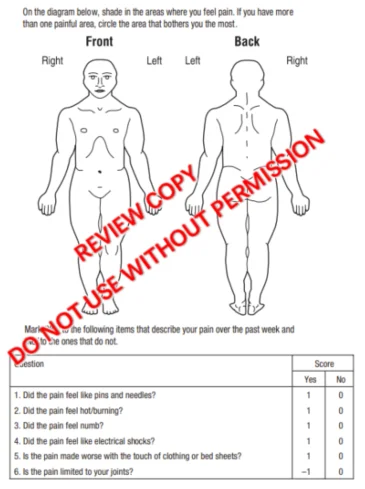
ID Pain Scale (ID Pain)
Overview:
Consists of 5 pain sensory items (pins and needles, burning, numbness, electric shocks, hyperalgesia; positively scored) and 1 joint pain item (negatively scored), with corresponding item scores and a total score ranging from -1 to 5 points.
Advantages:
Concise, easy to administer, and highly sensitive, it is commonly used as a rapid screening and assessment tool for neuropathic pain.
Limitations:
Its specificity is relatively low, so it is not suitable as a diagnostic criterion for neuropathic pain and should be used for reference only.
Note:
Domestic studies indicate that the reliability of ID Pain in assessing neuropathic pain remains to be further confirmed.
02
Leeds Assessment of Neuropathic Symptoms and Signs (LANSS)
Overview:
Includes 5 pain sensory items and 2 clinical signs, with a total score of 24 points.
Advantages:
Both sensitivity and specificity for assessing neuropathic pain are relatively high. It provides clear and easy-to-understand explanations of neuropathic pain terminology.
Limitations:
Relies on physician assessment, and the clinical signs examination requires stimulating the skin with a 23-gauge needle, which can easily be controversial; the listed pain assessment items are not comprehensive.
Note:
The commonly used version today is the self-report LANSS (S-LANSS), which replaces the clinical sign items with self-examination items using finger pressure and touch, while retaining the other pain sensation items.
03
Neuropathic Pain Questionnaire (NPQ)
Main content:
Includes 10 pain sensation items (such as numbness, pricking pain, and touch-evoked pain) and 2 self-assessment items, with each item scored as an integer from 0 to 100; scoring is relatively complex, with a total score ranging from -1.4 to 2.8.
Advantages:
Provides the most comprehensive assessment of neuropathic pain, and its scoring more readily reflects subtle differences and changes.
Limitations:
The special calculation formula may exhibit cultural differences across cultural groups and is not recommended for cross-cultural comparisons.
Note:
The short form of the NPQ includes only 3 items: numbness, tingling, and touch-induced pain.

04
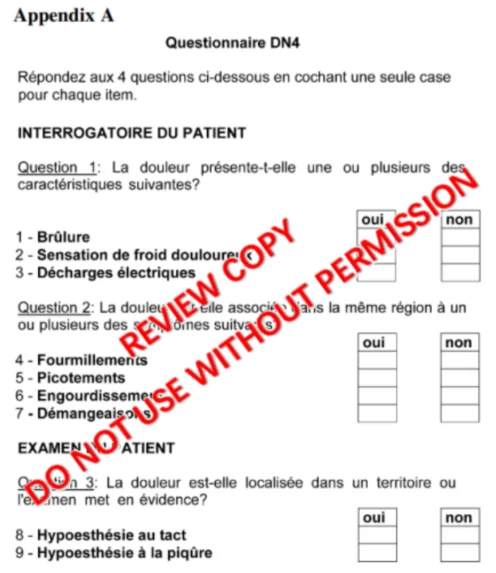
Douleur Neuropathique Scale (DN4)
Main content:
Includes 7 self-reported symptom items (burning, painful cold, electric shocks, tingling, pins and needles, numbness, and itching) and 3 clinical examination items (hypoesthesia to touch, hypoesthesia to pinprick, and pain evoked by palpation), with a total score ranging from 0 to 10.
Advantages:
Simple and easy to understand; patients can complete the self-assessment.
Limitations:
Each item lacks an explanation, and understanding of the translated terms is easily influenced by culture.
Note:
The short form of DN4 commonly used in clinical practice today includes only the 7 self-reported symptom items, omitting the clinical examination items.
05
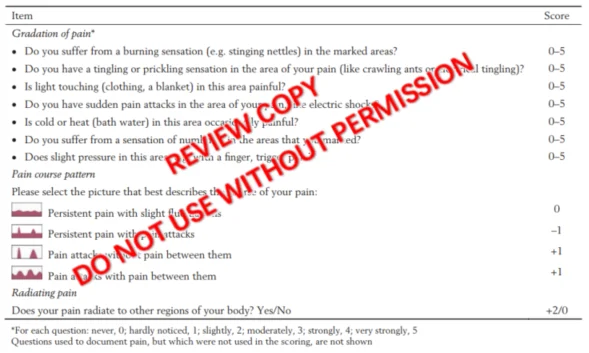
painDETECT Questionnaire (PD-Q)
Main content:
Includes 7 pain sensation items (0 to 5 points), 1 pain quality item (-1 to 1 points), and one radiating pain assessment (Yes/No).
Advantages:
Scores multiple types of neuropathic pain on a 0-to-5 scale, reflecting subtle differences in pain better than most questionnaires.
Note:
Lists radiating pain separately, with scoring criteria different from those of the other neuropathic pain items.
Comparison summary:
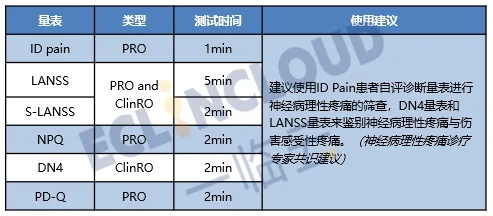
The scales above play an important role in pain assessment by accurately evaluating a patient's current pain status in a more objective manner, providing a concrete basis for formulating and adjusting treatment regimens and improving therapeutic outcomes.
What other aspects of pain assessment are there, and what other scales can be selected? Look forward to our next article.
EClinCloud has extensive project experience in clinical research eCOA projects. It not only maintains an extensive scale library, but also has an experienced team of experts providing one-stop scale services for sponsors and CROs, helping clients resolve scale-related issues in clinical trials faster and better while delivering comprehensive, high-quality services.You can contact us via direct message or by scanning the QR code below to submit your inquiry.
EClinCloud is a technology company dedicated to clinical research and development. It provides an integrated, interoperable, all-in-one clinical trial cloud platform (including different technology products such as eCOA, CTMS, eTMF, EDC, and RTSM, as well as solutions such as scale management, linguistic validation, rater training, and data quality analysis) and clinical trial endpoint assessment technologies across various therapeutic areas (including oncology, central nervous system, and ophthalmology, among others). Combining cutting-edge technology with life data, it builds a globally leading "patient-centered" clinical evidence support SaaS cloud platform to help domestic and international pharmaceutical companies and research institutions improve R&D efficiency, accelerate the market launch of drugs/devices, and benefit countless patients.