Case Studies | Incorporating Patient Experience Data into Clinical Trial Design to Support Drug Approval

Source: EClinCloud. Author: EClinCloud.


On August 9, the Center for Drug Evaluation (CDE) of the National Medical Products Administration (NMPA) issued three consecutive notices soliciting comments on draft guidelines for patient-centered clinical trials, systematically and thoroughly gathering input on guidance for the design, conduct, and clinical value assessment of patient-centered clinical studies.
Regarding clinical study design, the guideline states that trials should "adopt a fit-for-purpose design and incorporate patient experience data into considerations for key elements of clinical trial design. The overall study design should fully reflect clinical benefits to patients in terms of how they feel, function, and survive, thereby providing a basis for R&D and regulatory decision-making."1
Patient experience data are primarily used in clinical outcome assessment (COA), of which assessing patients' quality of life is a particularly important component. Today we share two successful case examples in which quality-of-life assessment data were incorporated into clinical trial endpoints to support R&D and regulatory decision-making.
Case 1
A Phase III clinical study published in The Lancet evaluated chlorambucil monotherapy (CHL) or chlorambucil combined with ofatumumab (O+CHL) in patients with chronic lymphocytic leukemia (CLL) who were ineligible for or had not previously received fludarabine. The study used the Global Health Status/Quality of Life domain of the EORTC QLQ-C30 to assess patients' health-related quality of life (HRQoL). The results showed that compared with chlorambucil monotherapy, the combination therapy significantly improved progression-free survival rates, though the rate of adverse reactions also increased significantly. Further analysis found that the higher incidence of adverse reactions did not reduce patients' HRQoL (Figure 1), and long-term observation showed that the combination therapy achieved greater clinical benefit without adversely affecting patients' HRQoL (Figure 2). This finding provided important data supporting FDA approval of this combination regimen as one of the first-line therapies for CLL.2,3
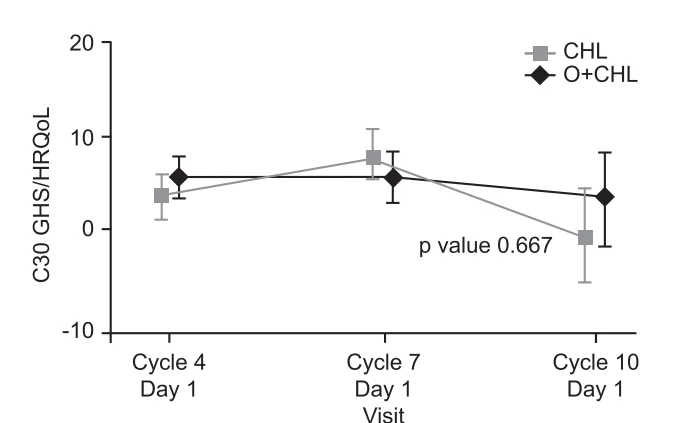
Figure 1: Change from Baseline in EORTC QLQ-C30 Global Health Status/Quality of Life Score
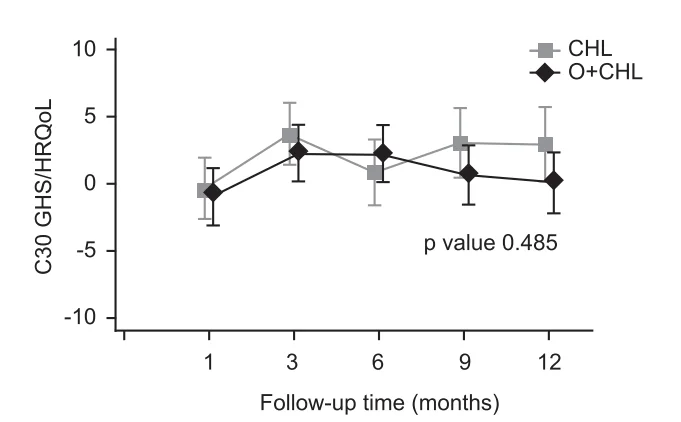
Figure 2: Change from Baseline in EORTC QLQ-C30 Global Health Status/Quality of Life Score During Long-Term Follow-Up
Case 2
Stewart et al. published a Phase III clinical study in The New England Journal of Medicine exploring the efficacy of carfilzomib combined with lenalidomide and dexamethasone in patients with relapsed multiple myeloma (MM). The study likewise used the Global Health Status/Quality of Life domain of the EORTC QLQ-C30 to assess patients' quality of life. The results showed that compared with patients who did not receive carfilzomib, those treated with the three-drug combination achieved more pronounced efficacy; although the rate of adverse reactions increased significantly, PRO data showed no statistically significant difference in symptom severity between the two groups and no reduction in patients' HRQoL (Figure 3). These results facilitated the approval of the three-drug combination as one of the standard regimens for patients with relapsed MM.1,4
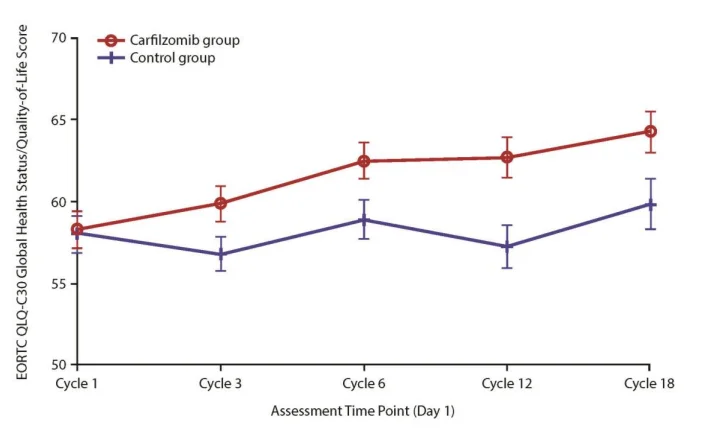
Figure 3: Mean EORTC QLQ-C30 Score
Summary
Previous studies have demonstrated1 that cancer severely impairs patients' quality of life; particularly for chronic malignancies with longer survival, patients often endure years of disease burden and treatment-related discomfort. Therefore, quality of life is an important indicator for evaluating treatment efficacy in oncology patients. As seen in the cases above, the fact that a drug therapy did not reduce—and even slightly improved—patients' quality of life was an important reason it could receive FDA approval; high-quality patient experience data can support drug approval and establish a therapy's place in clinical practice.
Scales Are Commonly Used Instruments for Collecting Patient Experience Data
Scales are measurement and assessment instruments commonly used in clinical settings and are essential for evaluating disease severity and supporting objective diagnosis and treatment. Compared with other examination methods, scales are simpler and more accurate to use, and have therefore become an important standard for measuring treatment effects in evidence-based medicine.
Currently, the use and management of scales in domestic clinical trials still encounter many difficulties; for example, using scales without copyright permission can easily lead to infringement and compliance issues, and obtaining scale copyright permissions is difficult, time-consuming, and costly.
How to Select a Scale
Scale selection must be determined according to factors such as the research area, study population, and pathological characteristics of the disease under study; based on the study objectives and study population, the study content is the most basic consideration, and aspects related to the health dimensions being measured should also be taken into account.
How to Obtain Scale Copyright Permission
Clarify the scale's usage scenario
Check whether it will be used in a commercial clinical trial, published in an academic journal, used in nonprofit clinical academic research, or used in a non-commercial clinical trial, among others.
Determine the scale version to be used
Scales may have different versions depending on factors such as participant age and sex.
Confirm copyright ownership and pricing
It is necessary to determine whether the scale is in the public domain and whether the Chinese version requires linguistic validation.
EClinCloud Scale Management Services
EClinCloud has an extensive scale library and an experienced team of experts, providing one-stop scale services:
A professional medical team to interpret protocols and determine the exact scale version;
An extensive scale library and strong collaborative relationships with multiple scale copyright holders for rapid response;
Extensive eCOA implementation experience, with experience in large-scale international projects across every stage, including copyright management, scale migration, device rental and maintenance, and data analysis and reporting;
Scale translation and linguistic validation services, including translation, reconciliation, back-translation, and cultural adaptation, among others;
Scale digitization services to make scale assessments and information collection more efficient and convenient.
Click to view EClinCloud's specific scale management services:
Service Overview | Scale Management
References
[1] CDE. Technical Guidelines for Patient-Centered Clinical Trial Design (Draft for Comments)
[2] Jiang Qian. Patient-reported outcomes and their application in hematologic malignancies. Chinese Journal of Hematology, 2019, 40(7):6.
[3] Hillmen, Peter et al. "Health-related quality of life and patient-reported outcomes of ofatumumab plus chlorambucil versus chlorambucil monotherapy in the COMPLEMENT 1 trial of patients with previously untreated CLL." Acta oncologica (Stockholm, Sweden) vol. 55,9-10 (2016): 1115-1120. doi:10.1080/0284186X.2016.1205217
[4] Stewart A Keith et al. "Carfilzomib, lenalidomide, and dexamethasone for relapsed multiple myeloma." The New England journal of medicine vol. 372,2 (2015): 142-52. doi:10.1056/NEJMoa1411321
About EClinCloud
EClinCloud provides an integrated, all-in-one cloud platform (including solutions such as CTMS, eTMF, EDC, RTSM, eCOA, and eConsent, and consulting services such as scale management, linguistic validation, rater training, and data quality analysis) as well as clinical trial endpoint assessment technologies across various therapeutic areas (including oncology, neurology, cardiology, pulmonology, and autoimmune diseases, among others). By combining cutting-edge technology with life-sciences data, it builds a globally leading, patient-centric SaaS cloud platform supporting clinical evidence to help domestic and international pharmaceutical companies and research institutions improve R&D efficiency, accelerate the launch of drugs and devices, and benefit countless patients.