Scale Basics | Is the Scale You Are Using Copyrighted?

Source: EClinCloud. Author: EClinCloud.
What is scale copyright?
Scale
Simply put, a scale is a measurement tool that typically consists of multiple items forming a composite score. Professional medical scales reflect general patterns summarized from extensive clinical practice, are statistically sound, and can be used for purposes such as disease screening and diagnosis.
Copyright
Copyright, also referred to as "author's rights," denotes the legal rights held by an author or another party (including a legal entity) over a work. In China, the term of copyright protection is the author's lifetime plus 50 years, expiring on December 31 of the 50th year after the author's death. In the United States, copyright protection can extend for 70 years after the author's death and has been retroactively extended several times; as a result, even works published in 1975 remain under copyright protection today and cannot be used freely.

(Click the image to view the answer)
Accordingly, the use of a scale in specific scenarios is protected by law until the copyright protection term expires.
 Let's take an example.
Published in 1975, the MMSE (Brief Cognitive State Assessment Scale, Mini-Mental State Examination) contains items assessing functions such as calculation, memory, language comprehension, visuospatial skills, and orientation, and has been widely used as a de facto standard for cognitive screening (such as screening for Alzheimer's disease).
However, in 2000, the scale's authors—Marshal Folstein, Susan Folstein, and Paul McHugh—transferred the scale's copyright to a specialized company for management to protect their rights. In 2001, that company granted an exclusive license for publishing and distributing the scale to Psychological Assessment Resources to manage its intellectual property. This meant that the Mini-Mental State Examination was removed from the public domain, and users must pay to obtain a license to use it.
How users obtain scale copyright permission
Identify the Usage Scenario for the Scale
We have summarized four common usage scenarios—see which one applies to you.
1. Using a copyrighted scale in a commercial clinical trial;
2. Referencing a copyrighted scale in an academic paper and publishing it in an academic journal;
3. Using a copyrighted scale in nonprofit clinical academic research;
4. Using a copyrighted scale in a non-commercial clinical trial.
Confirm the Scale Version to Use
A scale can have different versions depending on factors such as participant age (children, adolescents, adults) and sex (male, female), and over time it may also undergo content updates. Therefore, confirming the scale version is critical.
Copyright ownership and pricing confirmation
That is, it is necessary to determine whether the scale is in the public domain (referring to copyrighted works whose copyright protection term has expired and that have entered the public domain), and whether the Chinese version requires linguistic validation. Because copyright licenses vary, different scales belong to different copyright holders, and different copyright holders have varying requirements for copyright use. For example, the EORTC QLQ-C30 quality of life questionnaire for cancer patients requires purchasing a copyright license, granted per research institution without a time limit, with the license fee purchased in tiers based on participant count (that is, calculated according to the number of enrolled participants). The MMSE-2 Mini-Mental State Examination requires purchasing a copyright license, granted per research institution, and the questionnaires must be printed and mailed by the copyright holder.
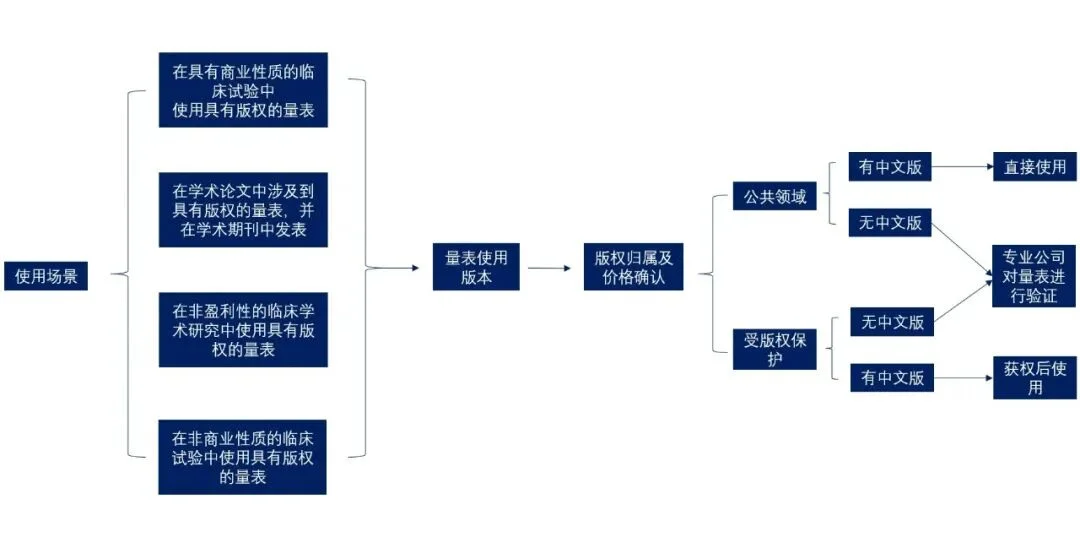
Once the three steps above have been determined, you can contact the copyright holder to purchase the scale and obtain authorization for it.
References: [1] Zhang Dongjuan. Copyright and Open Access in Clinical Practice [J/OL]. China Information World (e-Healthcare): 36-37 [2022-03-24]. https://xueshu.baidu.com/usercenter/paper/show?paperid=154c2ceef0ad2c53f302765ab0cac250&site=xueshu_se.

EClinCloud provides you with professional scale management services
EClinCloud has a professional medical team to interpret protocols and confirm the accurate scale version, maintains good working relationships with multiple scale authors and copyright holders with timely responses, and has extensive experience in copyright management—we have also purchased the MMSE and MMSE-2 scales mentioned above for many clients. As an added note, we are also well versed in migrating scales to electronic formats, and our professional eCOA team is always standing by to support you!
Scan the QR code below
for a free consultation on scale copyright questions