SCDM Conference Report | A More Reliable Foundation for Clinical Endpoint Assessment
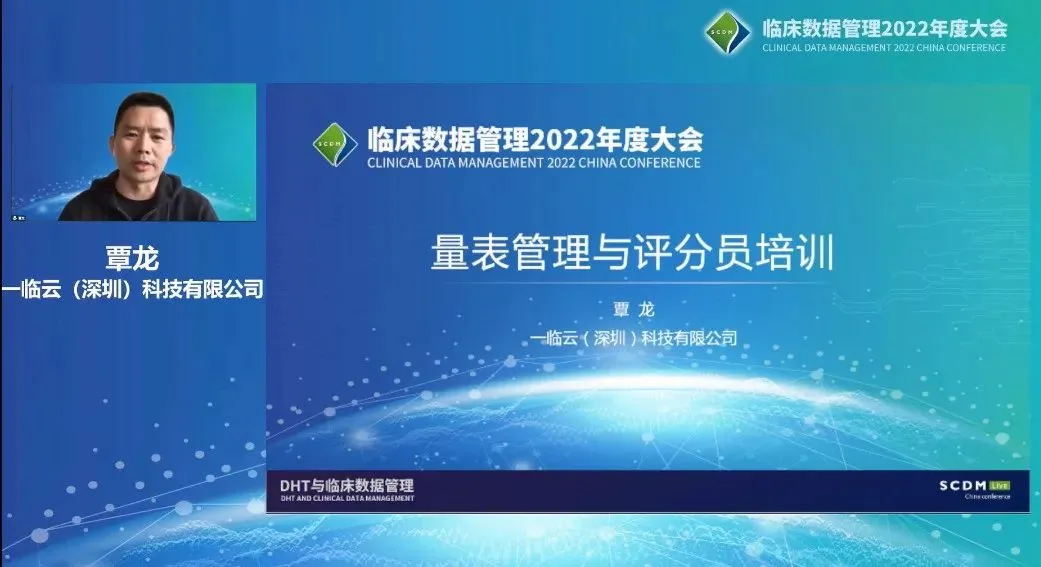
The Society for Clinical Data Management (SCDM) 2022 Annual Conference was successfully held online on November 17 and 18. Centered on the theme "DHT and Clinical Data Management," experts from various fields discussed the challenges, opportunities, and response strategies brought about by technological transformation in the digital era. Dr. Qin Long, CEO of EClinCloud, was invited to join a session on "Development Standards and Applications of Clinical Outcome Assessment (COA)," where he discussed "A More Reliable Foundation for Clinical Endpoint Assessment—Scale Management and Rater Training" with fellow experts, primarily covering scale acquisition, copyright management, use of translated versions, rater training workflows, and qualification certification.
Scales
Scales have long been a persistent challenge for sponsors: how can you select a more suitable scale? Does the scale version infringe copyright? How should the scale be translated? Are there any precautions to follow during use? Below, please review the process required to obtain a scale.
Scale Due Diligence
The sponsor needs to provide relevant clinical trial documentation so that scale due diligence can be conducted based on factors such as the proposed indication and scale requirements—comparing and analyzing key considerations across different scales for that disease area, contacting the scale copyright holder, and inquiring about the requirements and precautions for using the scale in China.
Scale Copyright and Use
Fees charged by a scale's copyright holder are affected by various factors, such as the context of use (e.g., commercial/academic research) and purchasing model (e.g., by project/duration of use/trial phase/number of trial participants/number of copies used, etc.), all of which require specific consultation with the copyright holder. In addition, it is necessary to confirm the specific version of the scale, carry out translation and validation for scales that do not have a Chinese version, and so on.
Due to their specific characteristics, some scales have requirements regarding the usage environment, materials, scoring algorithms, etc.—such as printing requirements (Visual Analog Scale) and the provision of scale user manuals, training materials, kits (props), etc.—all of which require specific consultation with the copyright holder to obtain a clear response.
Scale acquisition
There are two main ways to obtain a scale: developing a scale or licensing an existing one. Licensing an existing scale is more common, but the acquisition process is complex and time-consuming, so sponsors are advised to allow 6–8 weeks in advance to initiate scale copyright licensing.
*Note: Using a scale without authorization from the copyright holder may result in failure to pass article publication or clinical trial review.
ClinRO scale rater training
When using ClinRO scales as clinical trial endpoints, scoring errors often arise from non-standard rater practices such as subjective judgment, inconsistent interpretation, and leading language, having a major impact on the final results. To strictly control scoring errors and make scoring results more accurate, we provide comprehensive rater training to reduce human error, standardize scoring, ensure consistency of assessment results, and improve the reliability of endpoint results.
Rater Qualification Assessment and Certification

Raters' qualifications are screened against international standards (such as educational background, clinical experience, and scale usage). Raters who pass the assessment are then certified across three areas: the standard rater qualification process (QM), the Rater Experience Survey (RES), and study interview skills assessment.
Training Process
1
.
Scale Confirmation
l
Identify the scales requiring rater training
l
Obtain the scales and administration manuals
2
.
Training material preparation
l
Communicate with the expert team on scale training documents and key points
l
Certificate preparation
3
.
Document confirmation and finalization
l
Expert team drafts/provides training materials
l
Sponsor/PI reviews and confirms training materials
4
.
Training Plan
l
Methods, Time, and Location
l
Confirm training materials and assessment materials
5
.
Training implementation
l
Pre-training preparation (instructor confirmation, material preparation)
l
Scale training delivery (meeting moderation, photography and video recording)
6
.
Training and assessment
l
Simulated scoring scenarios
l
Assessment materials
l
Qualification assessment and management
l
Training certificate
Record management
Establish a rater management system to achieve long-term visual rater management, conduct various online/offline training activities to improve raters' skills, establish standardized management procedures, and record the entire rater qualification assessment process end to end on a long-term, cyclical basis.
About EClinCloud
EClinCloud
is a technology company focused on clinical research and development, providing an integrated, interoperable, all-in-one cloud platform for clinical trials (including
CTMS, eTMF, EDC, RTSM, eCOA
, and other technology products, as well as
scale management, linguistic validation, rater training, data quality analysis
, and other solutions) and clinical trial endpoint assessment technologies across different therapeutic areas (including oncology, central nervous system, and ophthalmology, among others). Combining frontier technology with life sciences data, it builds a globally leading
"patient-centric" SaaS cloud platform supporting clinical evidence to help domestic and international pharmaceutical companies and research institutions improve R&D efficiency, accelerate the market launch of drugs/devices, and benefit countless patients.