Review of RMB 10-Billion Drug Furmonertinib's Global Phase III Trial: Consistency Challenges in Endpoint Assessment
Source: EClinCloud. Author: EClinCloud.
On October 6, Allist announced that its core product, furmonertinib, failed to meet the primary study endpoint in the global pivotal Phase III FURVENT clinical trial.

Image source: Allist official website
Following the announcement, the market was quite surprised:
This is a domestically developed innovative drug that is already approved and marketed in China, has contributed over RMB 10 billion cumulatively in the domestic market, holds multiple indications, and previously received U.S. FDA Breakthrough Therapy Designation[1].
What happened behind it is worth examining in detail.
FURVENT Trial Review
FURVENT is a global, pivotal, three-arm Phase III clinical trial jointly conducted by Allist and its U.S. partner ArriVent to evaluate furmonertinib as first-line treatment for locally advanced or metastatic EGFR exon 20 insertion, non-squamous non-small cell lung cancer (nsqNSCLC). The trial enrolled a total of 398 patients who received furmonertinib 240 mg, furmonertinib 160 mg, or platinum-based chemotherapy combined with pemetrexed, including study sites in the United States, Europe, China, and Japan.
The trial's primary endpoint was blinded independent central review (BICR)-assessed progression-free survival (PFS).
Metric | Furmonertinib 240 mg | Furmonertinib 160 mg | Control arm |
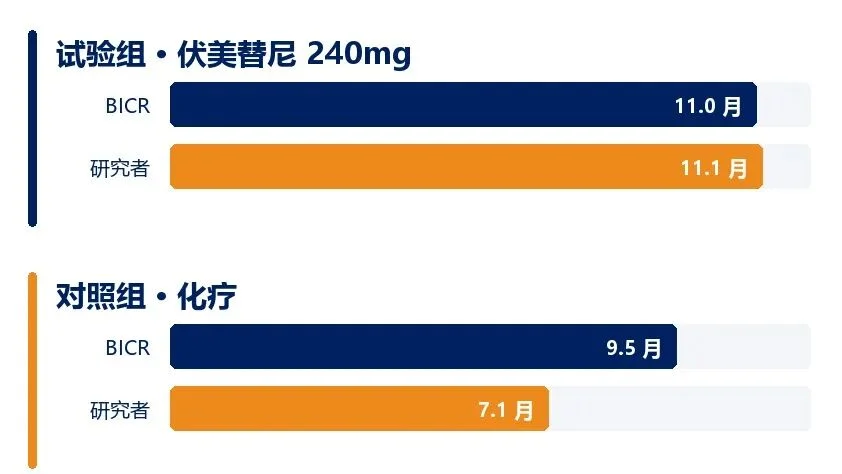
Median PFS (months) | 11.0 | 8.4 | 9.5 |
HR vs. control arm (95% CI) | 0.75(0.55, 1.02) | 0.91(0.67, 1.25) | — |
Confirmed ORR | 60% | 35% | 33% |
Primary results of the Phase III FURVENT trial (HR, hazard ratio; CI, confidence interval; ORR, objective response rate)
Several aspects of this dataset warrant attention.
First, the gap between the efficacy signal and the primary endpoint.
The data for the furmonertinib 240 mg arm were not poor. The ORR was 60%, nearly double the 33% seen in the control arm (hereafter referred to as the chemotherapy arm). The HR was 0.75, meaning the risk in the treatment arm was 75% of that in the chemotherapy arm, a 25% risk reduction.
However, while median PFS in the furmonertinib 240 mg arm was 11.0 months, the chemotherapy arm reached 9.5 months, a difference of 1.5 months (meaning furmonertinib extended PFS by only 1.5 months). The final trial P value was 0.0654[2], failing to meet the statistical significance threshold of P < 0.05.
Thus, the furmonertinib 240 mg arm demonstrated antitumor activity, but failed to prove clear superiority over chemotherapy on the critical PFS endpoint.
In Allist's view, the BICR-assessed median PFS of 9.5 months in the chemotherapy arm was markedly higher than results from recent comparable studies (where historical chemotherapy arm PFS was expected to be 5–7 months) and the company's internal expectations[3]. That is, the control arm "performed too well," affecting the efficacy margin between the treatment arm and the control arm.
Second, the asymmetry between BICR and investigator assessments.
The trial disclosed investigator-assessed data. In the treatment arm, BICR and investigator assessments were nearly identical, whereas in the chemotherapy arm, BICR-assessed median PFS was 9.5 months compared with only 7.1 months by investigator assessment, a difference of 2.4 months. This discrepancy was concentrated in the chemotherapy arm and pointed in a single direction, creating an asymmetry that affects the interpretability of the results and undermines confidence in the efficacy comparison.
In terms of the direction of discrepancy, BICR assessment was more "favorable" toward chemotherapy. Under investigator assessment, the furmonertinib 240 mg group versus chemotherapy was 11.1 months versus 7.1 months, with an HR as low as 0.61; however, under BICR assessment, the chemotherapy group increased from 7.1 months to 9.5 months.
Focus on Oncology Endpoint Assessment: BICR Cannot Be Overlooked
BICR (Blinded Independent Central Review) is a common endpoint assessment approach in oncology clinical trials.
Term | English Name | Focus |
BICR | Blinded Independent Central Review | Emphasizes characteristics of the assessment process such as blinding, independence, and centralized review |
IRC | Independent Review Committee | Emphasizes the committee undertaking the independent review work and the review mechanism |
IRC emphasizes "who conducts the review," while BICR emphasizes "how the review is conducted"; the related terms have overlapping usage in clinical research literature
Why Are Both BICR and Investigator Assessments Needed?
In oncology clinical trials, different efficacy endpoints vary in their degree of dependence on the assessment method. Overall survival (OS) is typically based on death events and their timing, offering relatively high objectivity; by contrast, radiographic determinations in endpoints such as ORR and PFS may be influenced by factors including lesion measurement, progression determination, and differences among assessors.
Especially in open-label clinical trials such as FURVENT in this case, investigators know which treatment regimen patients receive, which may introduce potential assessment bias; through independent, blinded, and centralized evaluation, BICR reduces assessment bias as much as possible and improves assessment consistency.
CDE explicitly states in its "Guidelines for Statistical Design of Antitumor Drug Clinical Trials" that, for trials intended for registration applications, ORR and PFS assessments of tumor response generally need to be based on tumor measurements and response evaluations conducted by a blinded independent review committee (BIRC); in its guidance on cancer drug endpoints, the FDA also explicitly discusses the value of independent review in reducing imaging interpretation bias[4].
Why Do Discrepancies Occur Between BICR and Investigator Assessments?
Concordance between BICR and investigator assessments is one of the key analytical discussion points in oncology trials. Discrepancies between the two are associated with the following factors:
● Lesion measurement differences: Assessments of lesion borders, changes in size, or new lesions may differ.
● Progression determination differences: Even when applying the same RECIST 1.1 criteria, different assessors may still reach different judgments on specific cases.
• Differences in assessment information: Investigators know the patient's clinical status, whereas central review typically performs readings according to the review charter and specified information.
● Timepoint and data-handling differences: Scan timing, missed assessments, missing images, subsequent therapies, and how progression events are confirmed can all affect PFS calculations.
Even in the absence of obvious misjudgments or missed assessments, discrepancies may still exist between investigator and BICR assessment results. Currently, no relevant regulations specify an acceptable discordance rate between the two. What matters is whether the discrepancies can be reasonably explained, whether systematic bias is present, and whether the reliability of the primary endpoint results is affected.
Could FURVENT Have Succeeded Under Investigator Assessment?
Based on the published data, investigator assessment did indeed show a more favorable efficacy signal. However, whether it can succeed still depends on whether regulators consider investigator assessment under open-label conditions sufficiently reliable, and whether the discrepancies between the different assessment methods are reasonable.
Lessons from This Case
The rigor of assessment determines the degree of confidence we can place in an efficacy signal. Ensuring through standardized design and execution that assessment data withstand scrutiny may be a lesson more worth remembering for the industry than any single absolute figure.
The FURVENT case reminds us that in global multicenter—and especially open-label—oncology trials, regulators pay close attention to concordance between BICR and investigator assessments. Sponsors must manage "differences between assessment systems" as a core risk, not only pre-specifying sensitivity analyses during protocol design, but also continuously monitoring assessment "consistency" and "data integrity" throughout the trial to address potential disputes.
For endpoints that rely on imaging-based assessment, such as PFS, the assessment criteria, image acquisition quality, imaging time points, data transmission and management, and workflow alignment between investigator assessment and independent central review can all affect the integrity and interpretability of endpoint assessment.
In addition, companies conducting multicenter—and especially international multicenter—clinical trials must ensure that different study sites execute procedures to uniform requirements, that key data are collected in a timely manner and managed in a standardized way, and that missing data or assessment discrepancies are promptly verified.
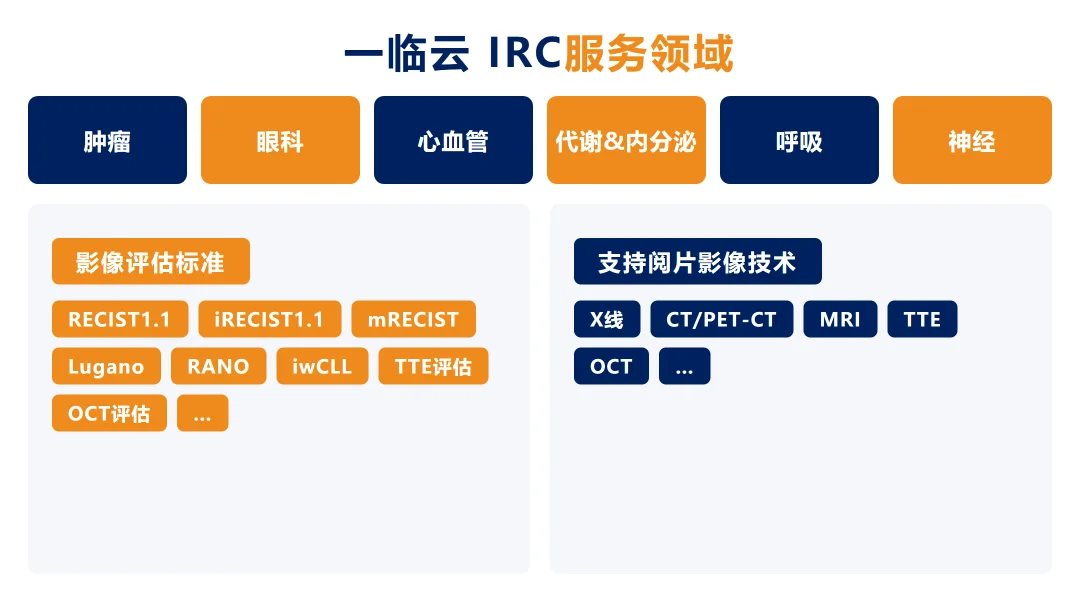
EClinCloud remains focused on endpoint assessment quality and workflow coordination in clinical research. In the IRC field, covering imaging endpoint assessment across multiple disease areas, we support multiple imaging assessment criteria and imaging technology applications and provide professional services to help study teams standardize assessments, improve consistency and traceability, and support the generation of reliable clinical evidence.

Behind every innovative drug lies the dedication and hope of countless people, along with many challenges. EClinCloud has supported many MRCT projects, and the deeper our involvement, the more keenly we appreciate how demanding they are.
The medical and pharmaceutical professionals on our team, together with the research experience we have accumulated across different disease areas, enable us to start from real clinical needs and consider what further support technology can bring to studies. We hope to work hand in hand with our partners to bring more valuable innovative therapies to patients.
[1] Shanghai Allist Pharmaceuticals Co., Ltd. Good News | Allist Announces U.S. FDA Breakthrough Therapy Designation for Furmonertinib as First-Line Treatment for Advanced or Metastatic Non-Small Cell Lung Cancer with EGFR Exon 20 Insertion Mutations [Online]. 2023-10-30. https://www.allist.com.cn/newsd/101/2076.html
[2] https://ir.arrivent.com/news-releases/news-release-details/arrivent-announces-program-update-phase-3-furvent-trial
[3] Allist Pharmaceuticals, "Investor Relations Activity Record," Shanghai Stock Exchange, 2026-10-09, Filing No. AN202610091830262783. https://pdf.dfcfw.com/pdf/H22_AN202610091830262783_1.pdf
[4] U.S. Food and Drug Administration (FDA). Clinical Trial Endpoints for the Approval of Cancer Drugs and Biologics: Guidance for Industry. December 2018, Section III. General Endpoint Considerations. https://www.fda.gov/regulatory-information/search-fda-guidance-documents/clinical-trial-endpoints-approval-cancer-drugs-and-biologics
*Disclaimer: This article is for industry exchange only and does not constitute investment or medical advice. All cited content is sourced from publicly available information.
EClinCloud is a leading AI company in the clinical research industry. Driven by AI, it develops an integrated intelligent clinical cloud platform and endpoint assessment technologies, providing global pharmaceutical companies and research institutions with technology products—including eCOA, CTMS, eTMF, EDC, RTSM, IRC, and RM—as well as scale management, linguistic validation, rater training, and data quality analysis services to build efficient, accurate digital solutions. Leveraging AI predictive models and an intelligent data platform, it dynamically assesses and helps improve the success rate of drug clinical trials, helping shorten drug/device R&D cycles to benefit patients.