Latest! "Guideline Variations" for Rheumatology Clinical Trials: From Draft for Comment to Final Release

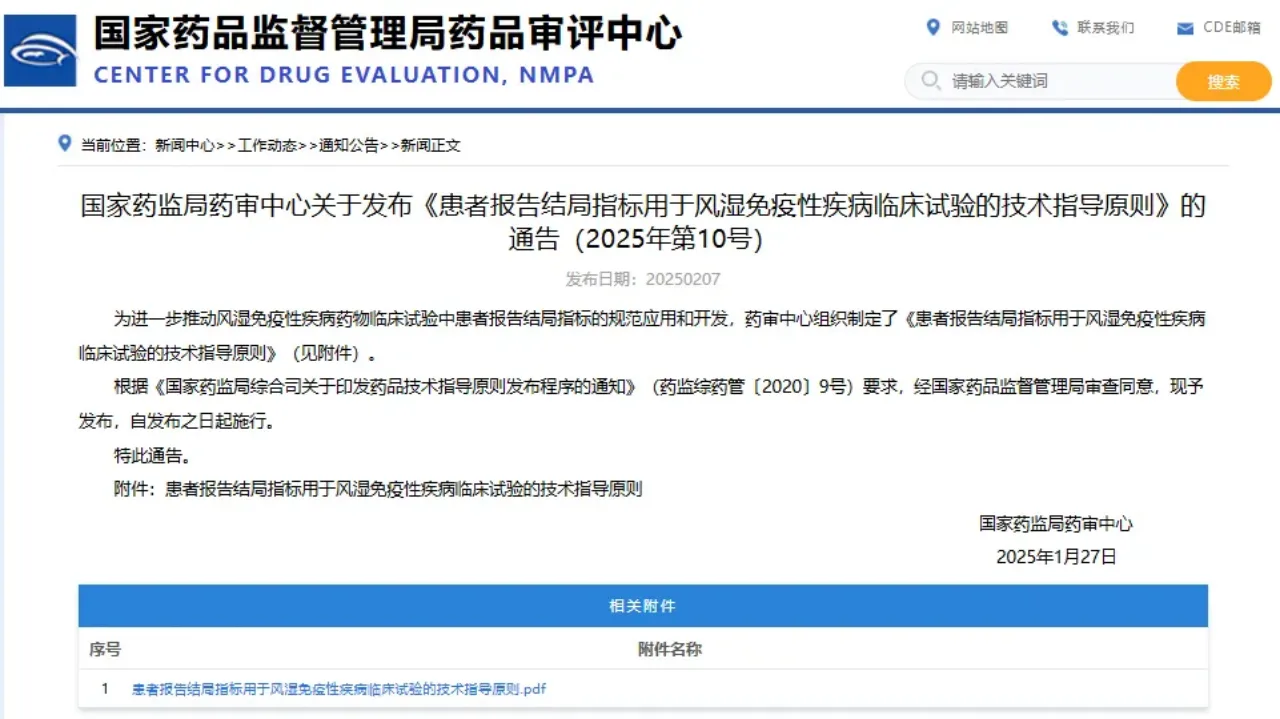
Recently,
the CDE officially released the "Technical Guidelines for the Use of Patient-Reported Outcomes in Clinical Trials of Rheumatic Diseases"[1]. Following a year and a half of rigorous preparation since its draft for comment was issued in June 2023, the guideline finally made its major debut in early 2025.
The content focuses primarily on the application and considerations of patient-reported outcomes (PROs) in clinical trials for
rheumatic diseases (RDs), filling a long-standing gap in standards for PRO application in this field and supporting the conduct of high-quality clinical trials and accelerated R&D.
Today, let's examine the draft for comment alongside the final release to see what interesting changes lie between them.
Minor changes to the name and
"opening introduction"
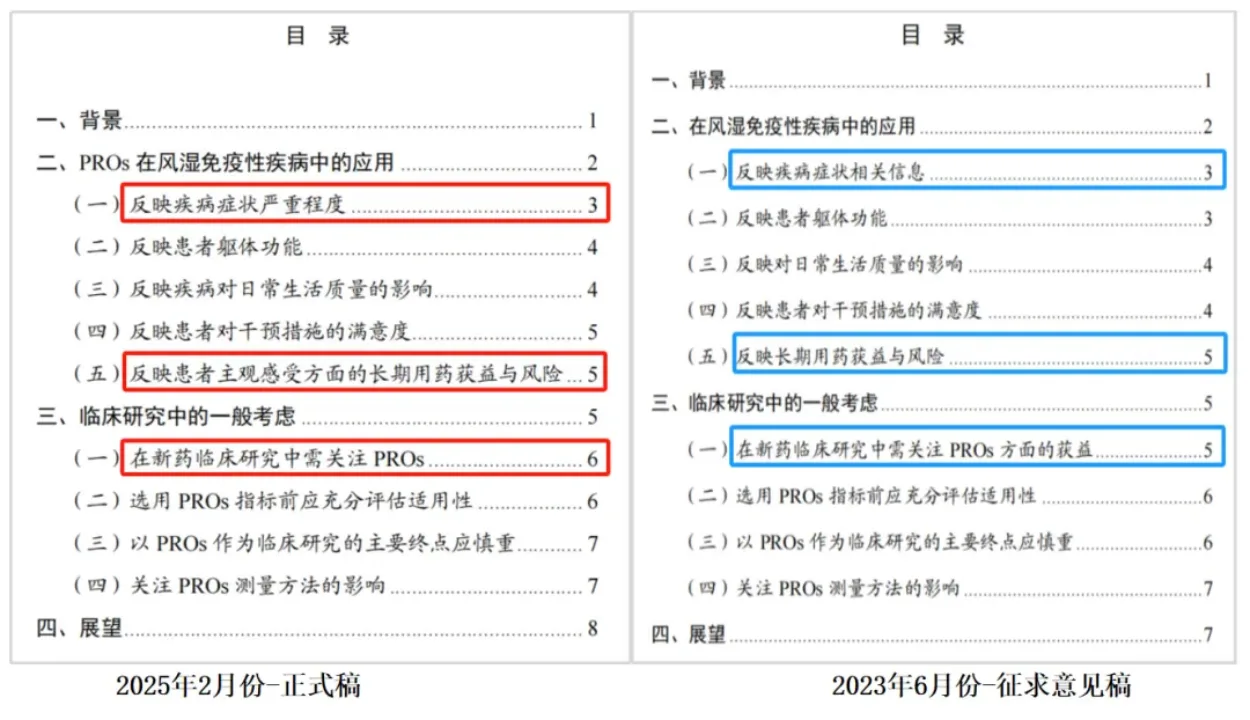
First, regarding the table of contents and naming: the descriptions in the table of contents were adjusted, and the English name and abbreviation for rheumatic diseases were standardized to
Rheumatic Diseases, abbreviated as RDs.
Turning to the background section, the final version reads as if it underwent a
"cosmetic tweak" to make the wording more concise and professional. At the same time, the phrase in the draft for public comment—"comprehensively evaluate the long-term efficacy and safety of the drug[2]"—was revised to "comprehensively evaluate the benefits and risks of the drug[1]," and it specifically notes that relevant studies and PROs results confirmed through communication with regulatory authorities may be included in the drug labeling. This is like drawing a clear map for researchers, showing the direction for their efforts and where the results will be "housed."
Application content
"levels up"
In the section on the application of PROs in rheumatic and immune diseases, the final version directly upgrades "reflecting information related to disease symptoms" to "reflecting the severity of disease symptoms," while streamlining the common clinical symptoms to "pain and fatigue"—much like archery, where previously only the direction was marked out, and now it aims straight at the bull's-eye!
[Taking pain assessment as an example, the Visual Analog Scale (VAS) was changed from the previous 10 cm to 100 mm. Although there is no mathematical difference, those familiar with VAS scoring will know the difference.]
For reflecting the impact on quality of daily life, the final version removes the original EQ-5D example and changes "improvement" to "change" in the draft-for-comment phrasing "it is often necessary to pay attention to the improvement in patients' subjective experience at different periods or stages of the disease[2]," further indicating that whether there is improvement, worsening, or the like, the collection of patients' experience should be more comprehensive. The final version also adds a point to note on interpreting PROs: "Even the same scale may differ across different diseases. For interpreting PROs, it is more important to consider widely accepted clinically important differences[1]."
For reflecting patient satisfaction with interventions, only minor adjustments were made to the content, such as revising wording and adjusting word order; it continues to emphasize focusing on patients' subjective experience and clinical needs, among other aspects.
To reflect long-term medication benefits and risks in terms of patients' subjective experience,
apart from minor wording adjustments, proactive communication with regulatory authorities is more strongly encouraged
—adding, "During the trial design stage, it is encouraged to comprehensively consider study duration, follow-up visits, study population, and other aspects to select an appropriate collection method and proactively communicate with regulatory authorities[1]."
Clinical Research Considerations:
"New Rules"
The final version adds, in
clinical trials of new drugs for RDs, considerations for disease definition and PROs instrument selection—"It is recommended to first rank disease-specific symptoms by importance and/or severity, and then select appropriate PROs measurement instruments[1]."
Meanwhile, compared with the draft for comment, the final version sets more detailed and stricter requirements for assessing applicability, specifically advising the tailoring of more suitable instruments
—"It is recommended to develop scales for the Chinese population and evaluate their suitability for use[1]" and "Unvalidated and unevaluated scale-based PROs measurement instruments should not be used in pivotal clinical studies[1]."
Regarding the use of PROs as primary endpoints in clinical studies, the final version again cautiously adds a new provision—"If PROs are planned to be used as the primary endpoint of a clinical study, timely communication with regulatory authorities should be conducted[1]." This is much like following traffic rules when driving: reporting in advance helps ensure a smooth journey.
Electronic Systems Make Their "Grand Debut"
With technological advances, electronic patient-reported outcomes (ePRO) are being used increasingly widely. In this regard, the final version does not differ from the draft for public comment, continuing to clearly state that the notable digital, remote, and real-time features of ePRO can make data collection more accurate, increase patient engagement, ease investigators' workloads, and also reduce costs.
EClinCloud can provide end-to-end services including an eCOA system, scale copyright management, and rater training, with experience in multiple RDs projects such as systemic lupus erythematosus, rheumatoid arthritis, ankylosing spondylitis, and osteoarthritis. We welcome your inquiries!
From the draft for public comment to the final version, these changes are like providing an upgraded toolkit for conducting clinical trials in rheumatic and immunological diseases. Following these new
"rules of the game," let us make good use of PROs and electronic systems, communicate proactively and promptly with regulatory authorities, keep "leveling up" on the path to overcoming rheumatic and immunological diseases, and bring more hope to patients!
References:
[1] Announcement of the Center for Drug Evaluation (CDE) of the National Medical Products Administration (NMPA) on Issuing the "Technical Guidelines for the Use of Patient-Reported Outcome Measures in Clinical Trials of Rheumatic and Immunological Diseases" (No. 10 of 2025)
https://www.cde.org.cn/main/news/viewInfoCommon/2333a5e1f8f2f932626d2c2e04506477
[2] Center for Drug Evaluation (CDE) of the National Medical Products Administration (NMPA). Notice on Soliciting Public Comments on the "Technical Guidelines for the Use of Patient-Reported Outcome Measures in Clinical Trials of Rheumatic and Immunological Diseases"
https://www.cde.org.cn/main/news/viewInfoCommon/e36df37c50ee7e4127c018d8c5459a2c