Three Consecutive FDA Rejections of a New Drug Application: What Are Regulators Focusing On?

On March 17, 2026, Aldeyra announced that the marketing application for its new dry eye disease drug Reproxalap (a novel eye drop intended to treat the signs and symptoms of dry eye disease) had once again received a Complete Response Letter (CRL) from the FDA. This marks the third time since 2023 that the FDA has declined to approve the product.
In the dry eye disease field, products such as Restasis (2002), Xiidra (2016), Miebo (2023), and Vevye (2023) have sequentially gained approval; Reproxalap, by contrast, is a rare case of three rejections—which is precisely why it serves as a "magnifying glass" for examining the FDA's review rationale.
First, What Is a CRL?
A CRL is a formal review communication issued by the FDA to a sponsor after completing its review of a marketing application when it determines that the current submission is insufficient to support approval. It does not mean that drug development has ended; rather, it indicates that the FDA considers the application package to still have issues that require supplementation or resolution.
In July 2025, the FDA released a batch of more than 200 CRL files to the public for the first time and subsequently explored establishing an ongoing mechanism for disclosing CRLs. Common reasons for non-approval in these letters include insufficient evidence of clinical efficacy, questions regarding safety data, and manufacturing deficiencies (CMC).
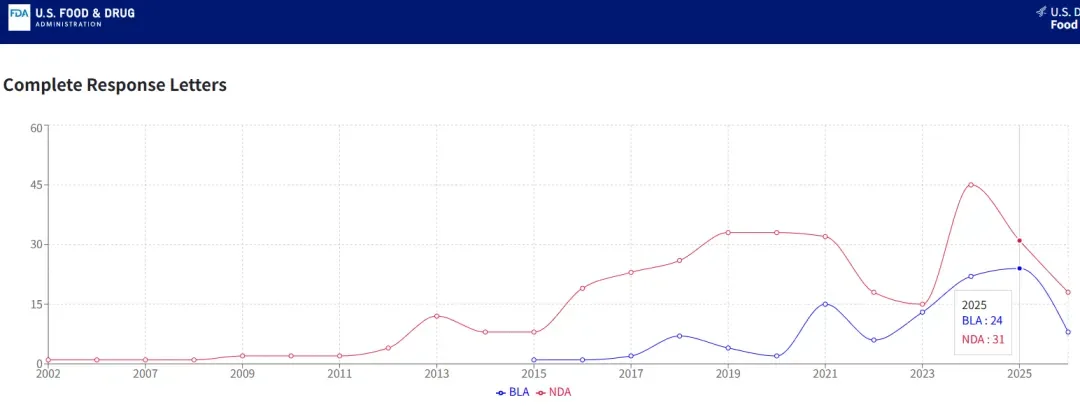
CRL trend chart published on the openFDA platform
In this case, the FDA did not raise new safety or manufacturing quality issues, focusing instead on whether the efficacy evidence was sufficient and whether the study results were consistent.
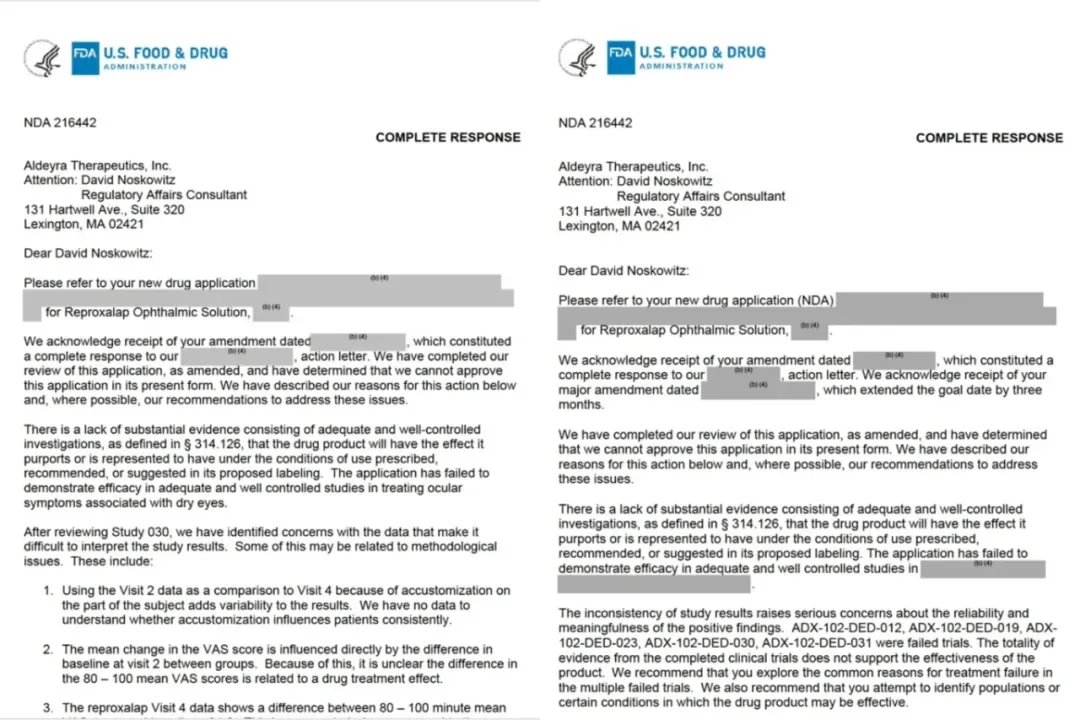
Original text of the CRL released by the FDA in this case
Background: One New Drug, Three Years, Three CRLs
Reproxalap is a small-molecule RASP (reactive aldehyde species) modulator with a mechanism of action distinct from traditional anti-inflammatory drugs; the company claims that symptom relief can even be observed within minutes of administration. Its proposed indication is the treatment of the signs and symptoms of dry eye disease (DED).
Timeline of the three CRLs:
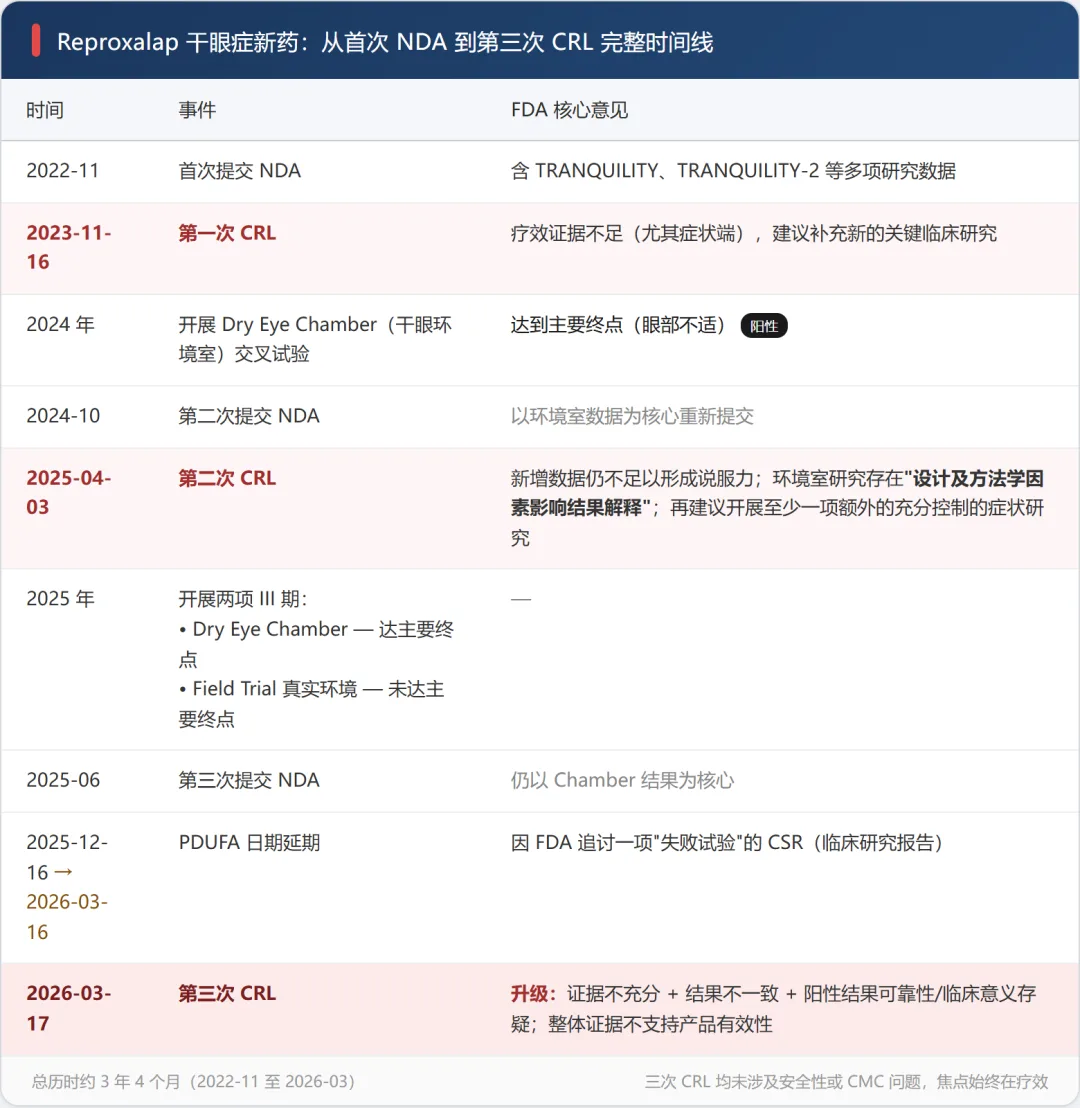
Across the entire development program, over a thousand patients were cumulatively enrolled. One clinical trial specifically evaluating long-term safety enrolled 757 trial participants—showing that Reproxalap had a substantial volume of data on the "safety" dimension, which helps explain why none of the three CRLs raised safety concerns; the obstacle consistently remained "efficacy."
Following the third CRL, Aldeyra stated that it currently has no plans to conduct new clinical trials and will request a Type A meeting to clarify the path to approval.
A Closer Look at the CRLs: What Is the FDA Questioning?
Dry eye disease is one of the more complex indications in ophthalmic clinical trials. A disconnect between subjective and objective measures is the norm in dry eye disease. Its efficacy evaluation relies simultaneously on:
Patient subjective experience (symptoms): eye dryness, foreign body sensation, ocular pain, etc.;
Objective ophthalmic examinations (signs): Schirmer tear test, corneal fluorescein staining, etc.
Extensive research shows that the two do not always align: some patients show marked improvement in signs without symptom relief, while others experience prominent symptoms lacking objective sign support. This makes it difficult for a single endpoint to fully capture drug efficacy in dry eye disease and inherently increases the complexity of interpreting the evidence.
For this reason, the FDA's dry eye disease drug development guidance requires a "dual-track" approach: sponsors must provide at least two adequate and well-controlled trials demonstrating improvement in both signs and symptoms.
1. "Design and Methodological Factors Affect Interpretation of Results"
This statement appeared in the second CRL and referred to the Dry Eye Chamber study that Aldeyra conducted as a follow-up. The FDA had three main concerns:
Baseline imbalance: In the chamber study, there were baseline differences in certain scores between the treatment and control groups at enrollment. Such an imbalance can "contaminate" a clean interpretation of the treatment effect—did the observed positive result come from the drug, or from differences in the two groups' starting points?
Limited external generalizability: An environmental chamber is a tightly controlled, artificial dry-eye induction setting in which patients are assessed under fixed temperature, humidity, and stimuli. Whether a "positive result under laboratory conditions" can be extrapolated to the highly variable daily lives of patients in the real world remains open to question.
Consistency of endpoint selection: In the TRANQUILITY trial prior to the first CRL, "ocular redness" served as the primary endpoint and did not meet its target; subsequently, TRANQUILITY-2 switched the primary endpoint to the Schirmer test (tear production) and achieved a positive result. Changing the primary endpoint mid-program led the FDA to question "whether the positive results were truly robust."
2. "Inconsistent study results"
In the third CRL, the FDA escalated its wording further, explicitly stating that "the inconsistency of study results raises serious questions about the reliability and clinical meaningfulness of the positive findings" and that "the totality of evidence from the completed clinical trials does not support the effectiveness of the product."
Reproxalap subjective and objective endpoint results:
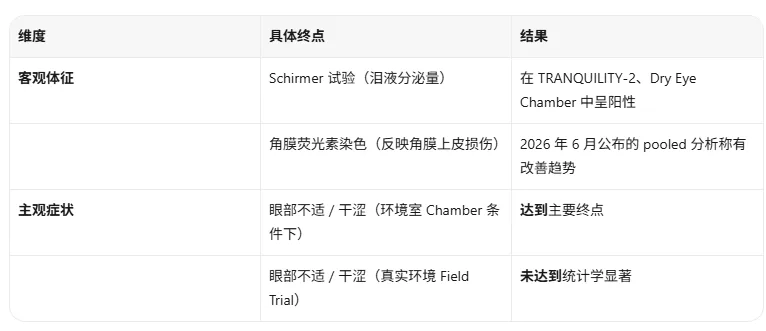
The "positive" results seen in a controlled environmental chamber could not be replicated in the real world. This is precisely what the FDA referred to in the third CRL as "inconsistent study results"—and why it further questioned "the reliability and clinical meaningfulness of the positive results."
The FDA's concern is not without basis: it focuses on whether these positive results can be consistently reproduced across different studies, settings, and patient populations to ultimately form consistent, credible overall evidence. This is also borne out by approved products—the registration studies for Restasis, Xiidra, Miebo, and others all demonstrated efficacy consistently across multiple pivotal studies, rather than relying on a single trial alone.
Lessons from this case
The issues Reproxalap encountered might have been prevented during the program initiation and protocol design stages.
First, build "consistency" into the development strategy rather than trying to remediate it after a CRL is issued. Sensitivity analyses and subgroup analyses should be prespecified at the protocol design stage, framing "which patient populations respond and under what conditions" as pre-testable hypotheses rather than post-hoc explanations. When "one positive and one negative" study outcome occurs, what the sponsor presents should not merely be a qualitative description of "numerical support," but a prespecified analytical framework capable of supporting the interpretation of results.
Second, both subjective and objective endpoints must withstand scrutiny, avoiding the temptation to focus only on what is easier to achieve. In TRANQUILITY, switching to the Schirmer test as the sole primary endpoint after the ocular redness endpoint failed to meet its target—this type of "endpoint switching" easily raises regulatory concerns over "selective reporting." A sounder approach is to plan a combination of endpoints capable of supporting both signs and symptoms from early development onward and maintain consistency throughout.
Third, include failed data within comprehensive evidence-chain management as well. The baseline questions raised in the second CRL, as well as the FDA's request for full clinical study reports (CSRs) of "failed trials," both point to the same reality—regulators review the full picture of a development program, not curated highlights. The earlier a sponsor establishes a mechanism in which "all study data are centrally archived and traceable," the faster and more completely it can respond when a CRL arrives.
Fourth, build a high-quality data system for endpoint assessment. The FDA is paying increasing attention to the data quality of clinical endpoint assessment, requiring not only statistically significant endpoint results, but also consistent processes and authentic, reliable data to form credible clinical evidence.
Taking this case as an example, the evaluation of objective signs in dry eye disease studies warrants particular attention. Endpoints such as ocular redness and corneal staining typically rely on the interpretation of slit-lamp photographs, where subjective variability exists across different study sites and investigators. Yet these very endpoints appeared repeatedly across multiple pivotal studies of Reproxalap—ocular redness served as a primary endpoint, and corneal staining was also included in efficacy evaluations. Therefore, reducing interpretation variability and improving evaluation consistency directly affect the reliability of endpoint data as well as regulators' confidence in the study results.
IRC (independent central reading) is primarily applied to objective endpoints that rely on medical imaging interpretation; through standardized reading criteria, centralized blinded assessment, and specialized reading workflows, it effectively reduces interpretation variability across different study sites and readers, thereby improving the consistency of endpoint assessment and data credibility.
In efficacy evaluations for dry eye disease, patients' perceived symptoms are equally critical endpoints, and the quality of those data relies on a different category of tools.
eCOA (electronic clinical outcome assessment) is used for subjective endpoints such as symptoms, visual function, pain, and quality of life, enabling authentic, real-time patient data capture, reducing recall bias and transcription errors, and enhancing traceability through end-to-end electronic audit trails.
For clinical endpoint assessment, EClinCloud provides integrated solutions including eCOA and IRC to help sponsors improve the quality of patient data collection, the consistency of endpoint assessment, and the traceability of study data, providing digital support for building more reliable clinical evidence that meets regulatory expectations.
It should be noted, however, that digital tools improve "data credibility," not "whether efficacy exists." For innovative drugs from China that are entering or preparing to enter global markets, as the FDA advances the public disclosure of CRLs, "rejection" is no longer a low-probability event to be downplayed; and "whether efficacy evidence can be reliably reproduced and fully traced" will increasingly become the key to clearing the hurdle.