The Earlier You Know, the More You Can Do: How Is Alzheimer's Disease Assessed?

Source: EClinCloud. Author: EClinCloud.
Every September is World Alzheimer's Month, and September 21 is World Alzheimer's Day. This year's World Alzheimer's Month theme is "The Earlier You Know, The More You Can Do: A Dementia Diagnosis Matters."
From identifying the disease earlier to more accurately assessing disease changes, clinical assessment has always been an important component of Alzheimer's disease (AD) research.
What do AD clinical studies actually assess? Many people first think of "cognitive function," such as memory, language, or executive function. In reality, a comprehensive AD study looks at far more than this[1][2][3]:
1. Has cognitive ability changed?
2. How severe is the disease?
3. Can the patient carry out daily activities independently?
4. Has quality of life been affected?
5. How much burden does the caregiver bear?
6. Are behavioral and psychological symptoms such as agitation present?
7. What changes have occurred on imaging?
These different dimensions need to be observed by combining different clinical outcome assessment (COA) tools and imaging assessment methods.
COA measurements are typically performed using validated scales. EClinCloud has extensive experience with scales in the AD field. We present them by category:
1. Cognitive Function Assessment
| Scale | Full Name | Purpose |
ADAS-Cog | Alzheimer's Disease Assessment Scale, Cognitive Subscale | Assesses patients' cognitive function and changes over time |
SIB | Severe Impairment Battery | Cognitive assessment in moderate-to-severe and severe AD |
MMSE | Mini-Mental State Examination | Used for early screening and cognitive assessment |
MoCA | Montreal Cognitive Assessment | Screening for mild cognitive impairment and multidimensional cognitive assessment |
2. Global Severity and Change
| Scale | Full Name | Purpose |
CDR | Clinical Dementia Rating | Staging of clinical dementia severity |
iADRS | Integrated Alzheimer's Disease Rating Scale | Comprehensively assesses patients' cognitive and functional status |
ADCOMs | Alzheimer's Disease Composite Score | Assesses cognitive and functional changes to reflect disease progression |
ADCS-CGIC | Alzheimer's Disease Cooperative Study–Clinical Global Impression of Change | Assesses patients' global clinical change and treatment response |
3. Activities of Daily Living
| Scale | Full Name | Purpose |
ADCS-ADL | Alzheimer's Disease Cooperative Study – Activities of Daily Living | Assesses activities of daily living |
ADCS-ADL-MCI | ADCS-ADL (MCI version) | Assesses activities of daily living in patients with mild cognitive impairment (MCI) |
FAQ | Functional Activities Questionnaire | Assesses instrumental activities of daily living |
DS | Dependence Scale | Assesses dependence and care needs in patients with AD |
4. Quality of Life and Caregiver Burden
| Scale | Full Name | Purpose |
QOL-AD | Quality of Life in Alzheimer's Disease | Psychometric data on patient-perceived quality of life rated by patients and caregivers |
ZBI | Zarit Burden Interview | Caregiver burden assessment |
RUD-Lite | Resource Utilization in Dementia – Lite Version | Healthcare resource utilization assessment |
5. Behavioral and Psychological Symptoms
| Scale | Full Name | Purpose |
CMAI | Cohen-Mansfield Agitation Inventory | Assesses the frequency of agitated behaviors in patients with cognitive impairment |
6. Imaging and Clinical Observation
| Scale | Full Name | Purpose |
MTA | Medial temporal lobe atrophy | Assesses the degree of brain atrophy shown on MRI |
eCOA is not merely the digitization of paper scales. Because Alzheimer's disease progresses in a complex and long-term manner, clinical studies in this condition present distinct characteristics in efficacy evaluation, clinical endpoint design, and data capture.
Multiple Assessment Dimensions: Electronic Capture Offers Advantages
AD studies involve numerous scales and complex evaluation dimensions, creating a greater need for digital data capture and management.
Long Follow-Up Periods and High Requirements for Data Integrity
The efficacy of AD drugs or interventions requires extended follow-up to be adequately evaluated, placing high demands on data integrity.
High Assessment Subjectivity Requires Standardization to Reduce Bias
The core symptom of AD is the progressive loss of cognitive function, making measurement somewhat subjective; scoring standards may also vary across different raters (patients, caregivers, and clinicians)[4].
The Value of eCOA
Through digital workflows, eCOA provides unified management of scales, assessment roles, assessment procedures, and endpoint data. It offers clear advantages in data-collection efficiency, real-time availability, flexibility, compliance, and patient privacy protection, helping generate more reliable clinical evidence.
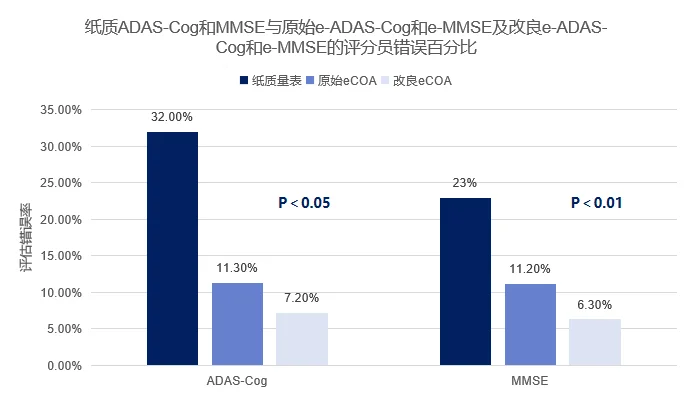
Data from the BN29552 (CREAD) study, a multinational clinical trial in patients with prodromal to mild AD, showed that using eCOA tools such as eADAS-Cog and eMMSE was significantly more effective in reducing scoring errors compared with paper scales[5].
In addition to scale-based assessments, AD clinical studies involve multiple imaging modalities such as MRI and PET to observe brain structure and disease-related imaging changes. Ensuring consistent evaluation standards across different study sites is critical for study quality control.
Subjective Variability in Image Reading Results
Different physicians may not reach completely consistent interpretations on the same MRI scan, and visual reading of PET scans also depends heavily on reader experience.
Need to maintain longitudinal consistency
AD-related imaging changes can be subtle, requiring consistent and comparable assessment of baseline and follow-up images.
Substantial challenges in multicenter studies
When images come from multiple sites, multiple scanners, and different sequence parameters, higher demands are placed on the standardization, consistency, and quality control of imaging assessment.
The value of IRC
Through centralized image management and standardized reading workflows, an IRC uses qualified and trained specialist readers to independently read and review study images against prespecified assessment criteria, reducing the impact of inter-site and individual reader variability on assessment outcomes and helping studies obtain more standardized, consistent, independent, and traceable imaging endpoint data.
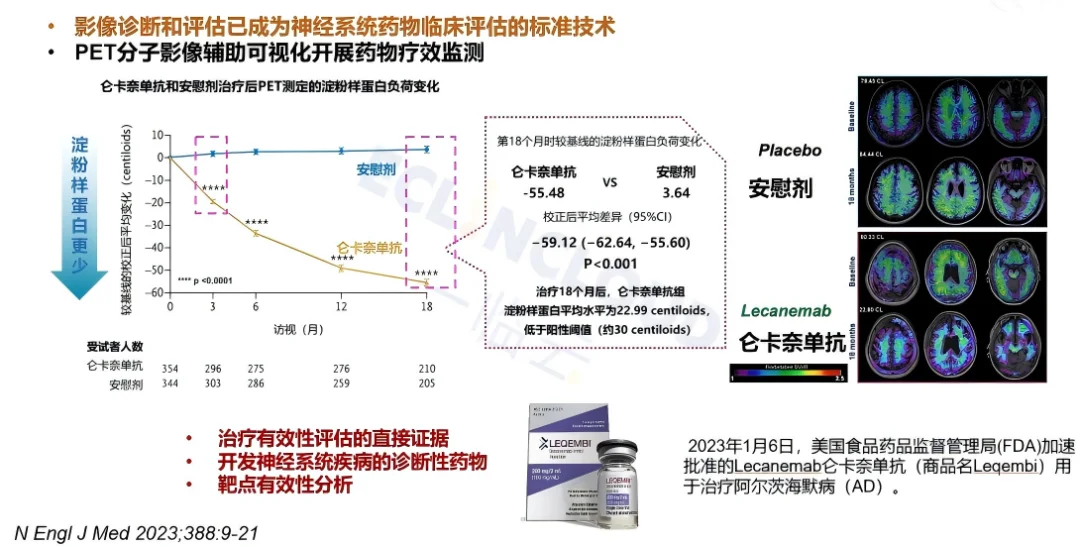
The case above is from an Alzheimer's disease drug clinical study that used PET imaging to quantitatively analyze brain amyloid burden; through standardized imaging assessment, it provided objective imaging evidence for evaluating drug efficacy[6].
Deep CNS experience
Extensive successful case experience
Through long-term project practice, EClinCloud has continuously accumulated clinical outcome assessment (COA) experience across different development stages and study settings.
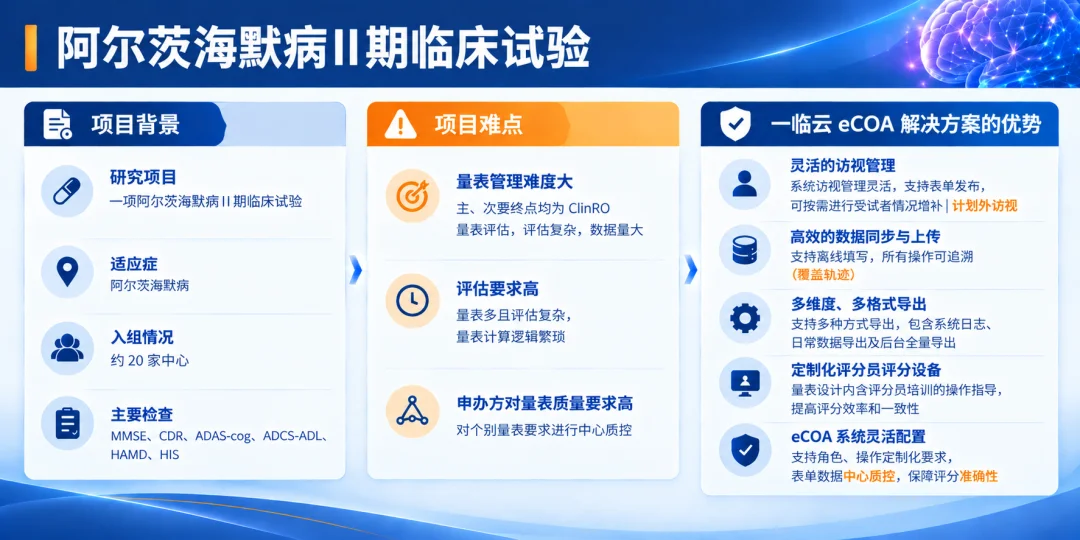
What we can do
Experienced with scales across multiple indications and supported by an extensive scale library, offering integrated services covering scale due diligence, copyright acquisition, translation and linguistic validation, and scale delivery.
A multilingual, globally compatible system that is concise and efficient, provides comprehensive functional support without adding reporting burden, and features a complete, robust closed-loop data workflow.
One-stop management covering trainer coordination, training material preparation, rater training delivery, and training assessment, reducing inter-rater variability and improving endpoint reliability.
Supports reading system and independent reading service solutions across multiple therapeutic areas, helping improve the consistency and reliability of endpoint assessment.
1. EMA. Guideline on the clinical investigation of medicines for the treatment of Alzheimer’s disease – Revision 2.
2. Molinuevo JL, et al. Outcome measures for Alzheimer's disease: A global inter-societal Delphi consensus. Alzheimer's & Dementia, 2023.
3. FDA. Early Alzheimer’s Disease: Developing Drugs for Treatment – Guidance for Industry.
4. U.S. FDA. Patient-Focused Drug Development Glossary / Clinical Outcome Assessment (COA) definitions.
5. H. Todd Feaster PsyD, Todd M. Solomon PhD, et al. The Impact of Electronic Clinical Outcome Assessments (eCOA) on Alzheimer’s Disease Clinical Trial Data Quality. Presented at the AAIC Annual Meeting, July 14–20, 2017, London, England.
6. van Dyck CH, et al. Lecanemab in Early Alzheimer’s Disease. N Engl J Med. 2023;388(1):9–21.
EClinCloud is a leading AI company in the clinical research industry. Driven by AI, it builds an integrated intelligent clinical cloud platform and endpoint assessment technologies to provide global pharmaceutical companies and research institutions with technology products including eCOA, CTMS, eTMF, EDC, RTSM, IRC, and RM, along with scale management, linguistic validation, rater training, and data quality analysis services to create efficient and accurate digital solutions. Backed by AI predictive models and an intelligent data platform, it dynamically assesses and helps improve drug clinical trial success rates, helping shorten drug/device R&D cycles to benefit patients.