Stay Away from Depression — Check Out the Depression Self-Rating Scale

Source: EClinCloud. Author: EClinCloud.
[Introduction]
Recently, renowned singer Coco Lee tragically passed away due to depression. When the news broke, it caused widespread shock. Amid the shock and grief, people have also begun paying closer attention to mental health. Anyone can face the risk of depression. So, what is depression, and how can you tell if you have it?

01
What We Should Know About Depression
Major depressive disorder (MDD) is the most common type of depressive disorder[1]. As a chronic, recurrent illness, its symptoms—such as depressed mood, slowed thinking, fatigue, and lethargy—severely impair patients' academic, daily, and social functioning[2]; meanwhile, its high incidence, high recurrence rate, and high suicide rate also place a heavy burden on patients and public healthcare services.
If you experience depressed mood in daily life, such as:
Feelings of inferiority, self-blame, depressed mood, or pessimism
Loss of confidence in the future of your work, studies, or life
Loss of interest and loss of pleasure
Even feeling that life is worse than death and each day drags on like a year
Thoughts of self-harm or suicidal attempts and behaviors
02
Are There Medications to Treat Depression?

Marketed Drugs for Depression
Currently, commonly used clinical medications for MDD include:
Selective 5-HT (serotonin) reuptake inhibitors (SSRIs, such as escitalopram, sertraline, and fluoxetine)
5-HT (serotonin) and norepinephrine reuptake inhibitors (SNRIs, such as venlafaxine and duloxetine)
Noradrenergic and specific 5-HT (serotonergic) antidepressants (NaSSAs, such as mirtazapine)
Tricyclic and tetracyclic antidepressants
Monoamine oxidase inhibitors (MAOIs)
Among these, SSRIs and SNRIs are currently the mainstay drugs for MDD, yet most have drawbacks such as slow onset of action, limited response rates, and causing sexual dysfunction and cognitive impairment. In addition, traditional Chinese medicines for MDD have also been approved and marketed in China in recent years, mainly including Yiling Pharmaceutical's Jieyu Chufan Capsules, Kanghong Pharmaceutical's Shugan Jieyu Capsules, and Zuoli Pharmaceutical's Wuling Capsules, among others.
Investigational Drugs for Depression
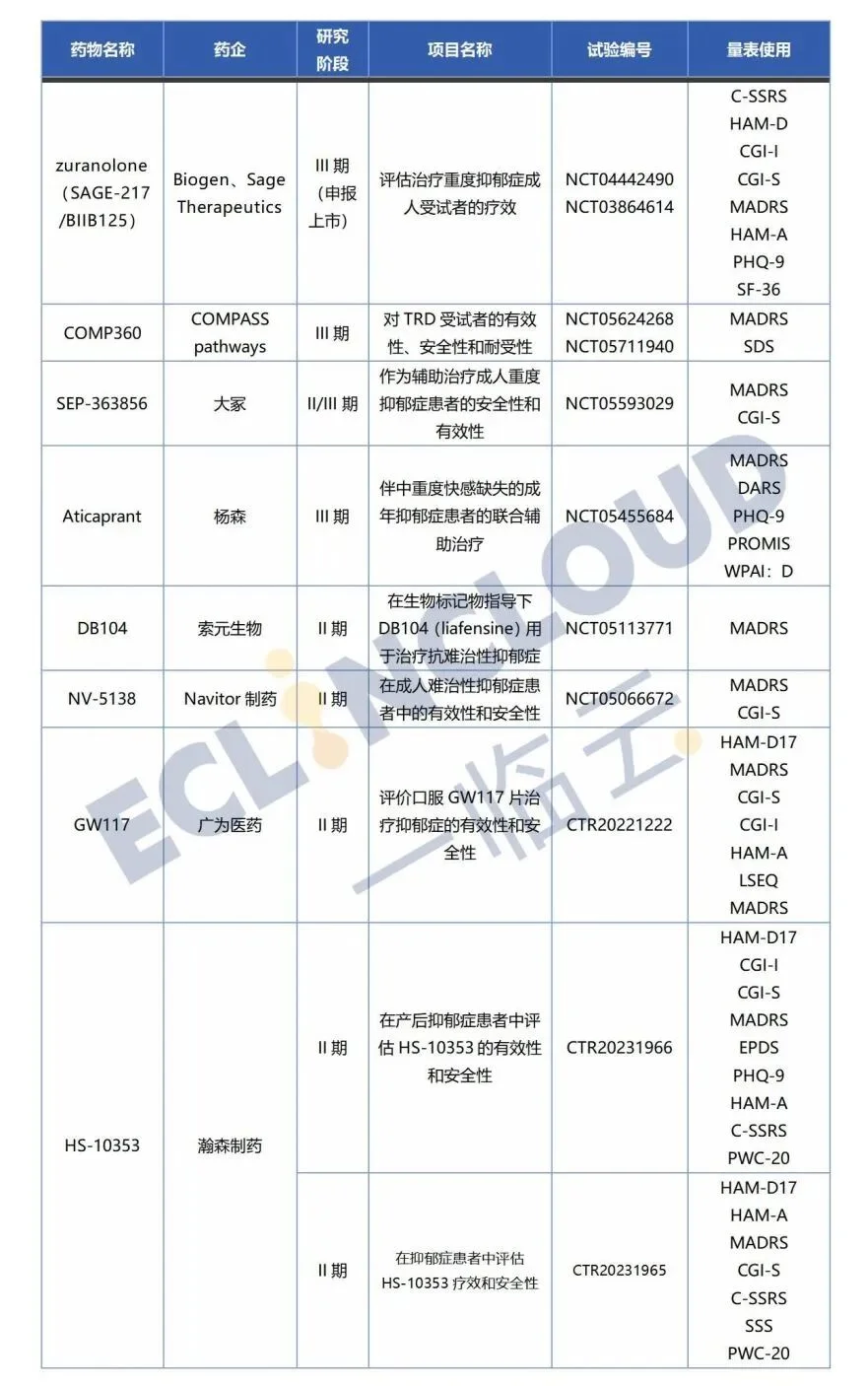
Note: In February 2023, the FDA accepted the marketing application for zuranolone for the treatment of severe MDD and postpartum MDD and granted it Priority Review, with a PDUFA date of August 5, 2023.
03
How Can You Tell If You Have Depression?
The most widely used depression assessment tool in clinical research is the Montgomery-Asberg Depression Rating Scale (MADRS). Other commonly used depression scales include the Hamilton Depression Rating Scale (HAMD) and the 9-item Patient Health Questionnaire (PHQ-9). We have compiled relevant information on these commonly used depression scales below for a closer look.
Montgomery-Asberg Depression Rating Scale (MADRS)
The MADRS is a depression subscale developed by Montgomery SA and Asberg M in 1979 from the Comprehensive Psychopathological Rating Scale (CPRS), with the aim of reorganizing a scale sensitive to changes in depressive symptoms, particularly the effects of antidepressant treatment. The MADRS consists of the 10 most common and sensitive depressive symptoms from the CPRS, uses a 7-point rating scale from 0 to 6, and is widely used in pharmaceutical research in the mental health field.
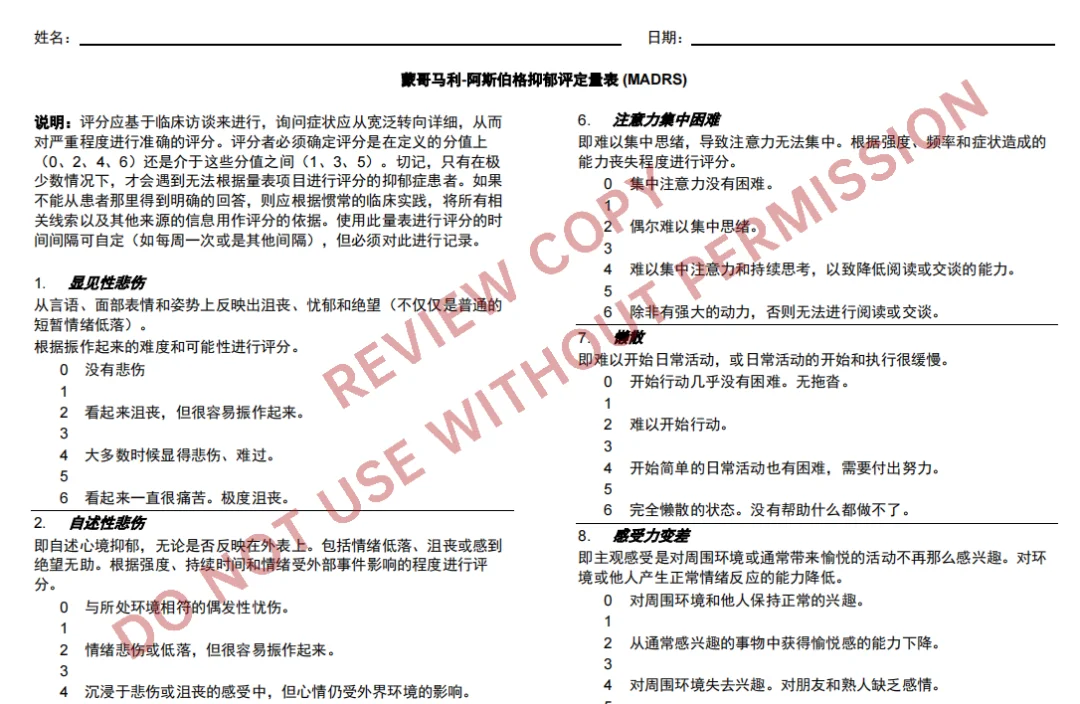
The scale should be administered by experienced specialist practitioners as raters; except for item 1, which is an observation item, all remaining items are rated based on the subject's self-report. The assessment uses an open-ended format similar to a general clinical interview and takes 15 minutes per assessment. The total MADRS score ranges from 0 to 60. Generally, a score of 0–11 is considered to indicate no clinically significant depressive symptoms, 12–23 mild depression, 24–34 moderate depression, and >35 severe depression. The scale demonstrates good reliability and validity, with inter-rater reliability R = 0.89–0.95.
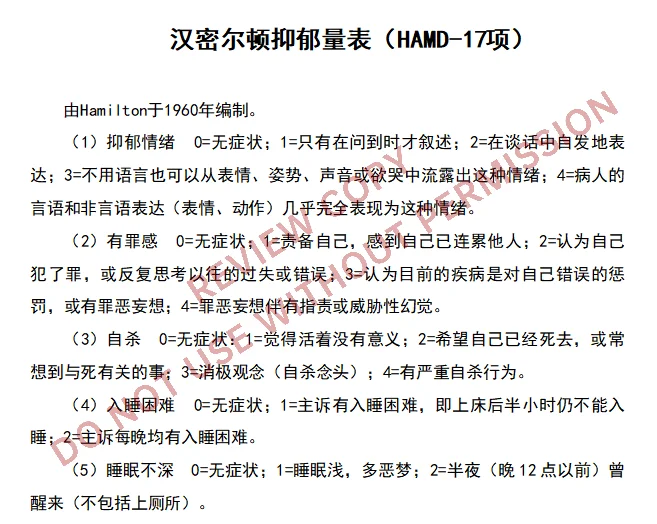
Hamilton Depression Rating Scale (HAMD)
9-Item Patient Health Questionnaire (PHQ-9)
The PHQ-9 is derived from the depression module of the Patient Health Questionnaire (PHQ) developed by Spitzer et al. (1999), also known as the Patient Health Questionnaire Depression Scale; it is widely recommended for its ease of use. The scale comprises 10 items in total, including a 9-item symptom scale and 1 overall functional assessment item. The symptom scale assesses: (1) diminished interest, (2) depressed mood, (3) sleep disturbances, (4) fatigue, (5) eating disturbances, (6) feelings of inferiority, (7) difficulty concentrating, (8) psychomotor retardation, and (9) suicidal symptoms; item 10 is an overall functional assessment. It uses a 4-point scoring system from 0 to 3, rated according to the frequency of symptoms over the past 2 weeks.
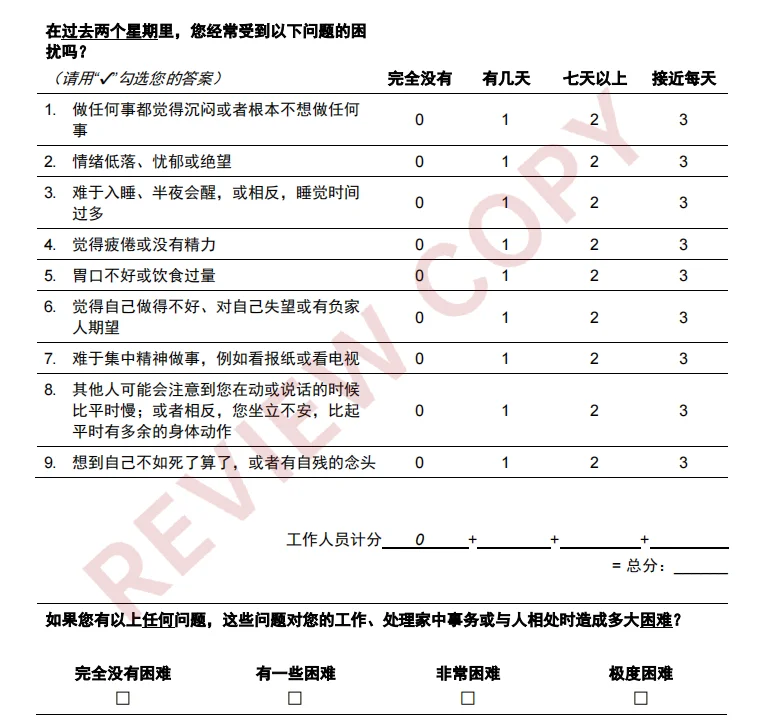
0–4 points: no depressive symptoms
5–9 points: mild
10–14 points: moderate
15 points and above: severe

Depression is nothing to fear—face it squarely, understand it, and treat people living with depression with kindness. If you have friends or family members around you who have been diagnosed with depression or show depressive tendencies, we hope that by learning about depression, you can help them seek formal treatment and support them out of the darkness with greater kindness and care. Believe that one day you can make peace with it.
References
[1] Chinese Medical Association, Chinese Medical Journals Publishing House, Chinese Society of General Practice, et al. Guideline for Primary Care of Depressive Disorder (2021) (抑郁症基层诊疗指南(2021年)). Chinese Journal of General Practitioners, 2021, 20(12): 1249-1260.
[2] Luo Yang, Shi Jing, Zhang Mingxia, Ding Zhuolei, Liu Sijia, Zan Siyan, Du Ruonan, Tan Yunlong, Yang Fude, Wang Zhiren. Characteristics of Intrinsic Motivation in Patients with Depression (抑郁症患者的内在动机特征). Chinese Mental Health Journal, 2023,37(4): 279-285.
[3] Ding Qinzhang. Treatment Guidelines for Depression (抑郁症的治疗指南). Chinese Journal for Clinicians, 2002,30(3): 21-22.
[4] Zhang Mingyuan, He Yanling. Handbook of Psychiatric Rating Scales (精神科评定量表手册). Hunan Science and Technology Press, 2015.
EClinCloud is a technology company focused on clinical research and development. It provides an integrated, interoperable all-in-one clinical trial cloud platform (including solutions such as scale design, scale copyright management, linguistic validation, rater training, and data quality analysis across technology products and offerings including eCOA, CTMS, eTMF, EDC, RTSM, and RM) as well as clinical trial endpoint assessment technologies across therapeutic areas (including central nervous system, ophthalmology, and others). By combining cutting-edge technology with life data to build a globally leading "patient-centric" clinical evidence support SaaS cloud platform, it helps domestic and international pharmaceutical companies and research institutions improve R&D efficiency, accelerate the market launch of drugs and medical devices, and benefit countless patients.