NewsSource: EClinCloud

Still Not Using Something This Good? An Accelerator for Clinical Trials Is Here
7 min readEClinCloud Editorial Team
Article illustration

Source: EClinCloud. Author: EClinCloud.

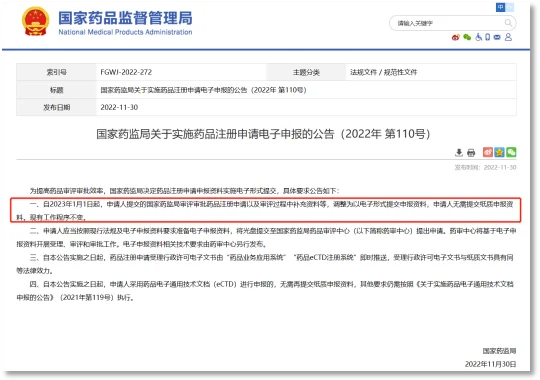
In November 2022, the National Medical Products Administration (NMPA) issued the "Announcement on Implementing Electronic Submission for Drug Registration Applications," stating that "effective January 1, 2023, drug registration applications submitted by applicants for National Medical Products Administration (NMPA) review and approval, as well as supplementary materials during the review process, will transition to electronic submission, and applicants do not need to submit paper dossiers."

With the arrival of the electronic Common Technical Document (eCTD) era for pharmaceuticals in China, requirements and standards for the Trial Master File (TMF) have also become increasingly stringent. As one of the foundations for efficient eCTD execution—a high-quality eTMF system has become particularly important.

Article illustration

Previous guidelines and regulatory requirements have also governed TMF management:

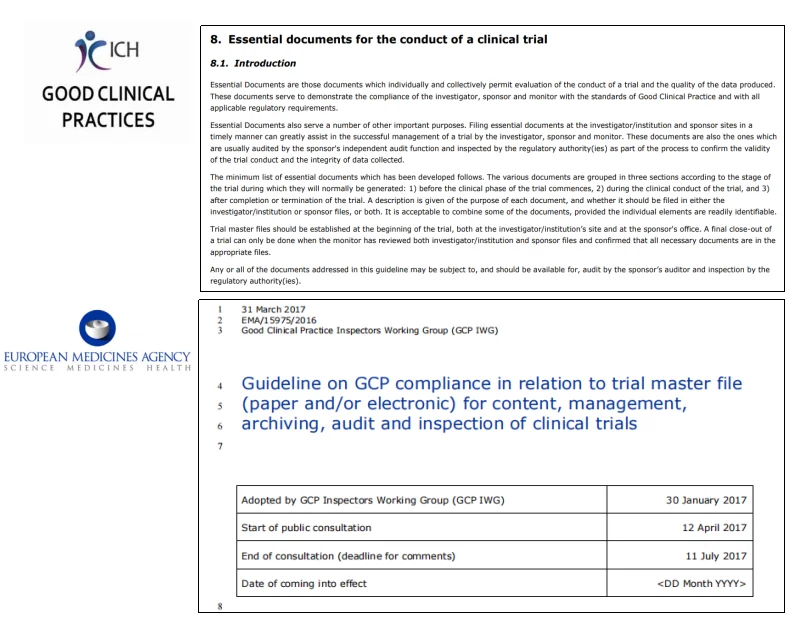
✍ In 2016, ICH-GCP E6(R2), updated by the International Council for Harmonisation (ICH), introduced the concept of essential documents for the TMF and specifically defined the trial data and documents that need to be collected, retained, and approved in clinical trials.


✍ In 2017, the European Medicines Agency (EMA) issued a dedicated Trial Master File guideline. While aligning with the updated GCP requirements, it provided more detailed provisions on TMF archiving, retention periods, digitization, and the destruction of paper documents, aiming to integrate the TMF requirements covered in ICH-GCP E6 and that regulation to improve trial submission efficiency.
Article illustration

Please enter title here


What Is eTMF?

Search
The Trial Master File (TMF) is the document repository required by regulatory authorities to monitor and evaluate whether a clinical study follows the approved protocol and complies with Good Clinical Practice (GCP). In its simplest form, an eTMF provides an electronic method for collecting and managing important TMF trial documents.

A good eTMF system is not merely a shift from paper processes to electronic workflows. While ensuring the evaluation of clinical trial conduct, trial data integrity, and GCP compliance, it should also enable real-time management of important documents, centralize data generated by clinical trials to facilitate cross-functional collaboration, and genuinely provide convenience in organizing clinical trial documents and reduce the burden on all parties.


What Sparks Fly When Tradition Meets Technology?
Search
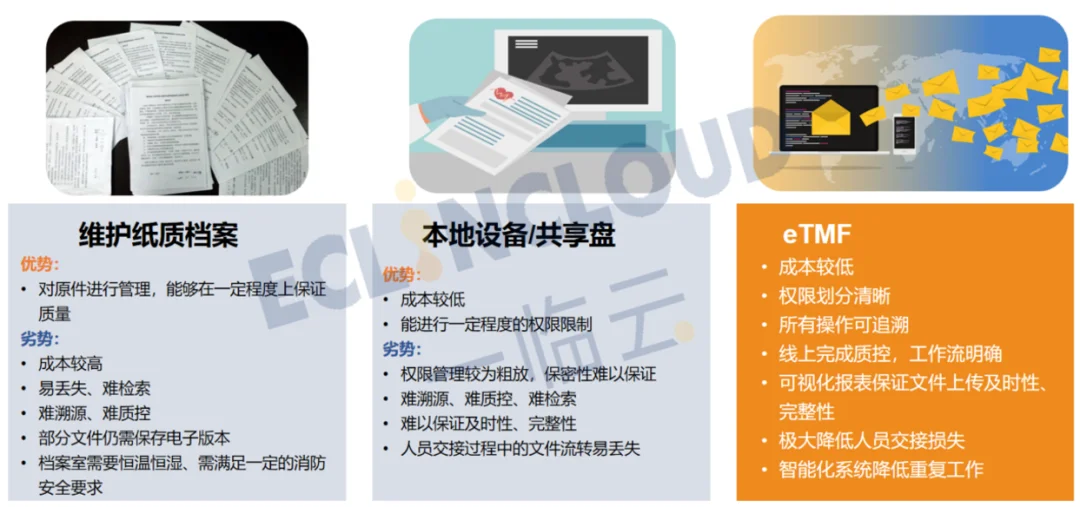
Traditionally, clinical trial documents were collected on paper. With the development of electronic technology, various document collection and storage methods gradually emerged—such as local document systems, cloud file-sharing systems, and content management systems. While these can largely alleviate the inconveniences of managing and storing paper documents, they have not genuinely helped advance clinical trials.
To further make a positive impact across the entire clinical trial, we still need to look at how our eTMF system performs.

Article illustration

 
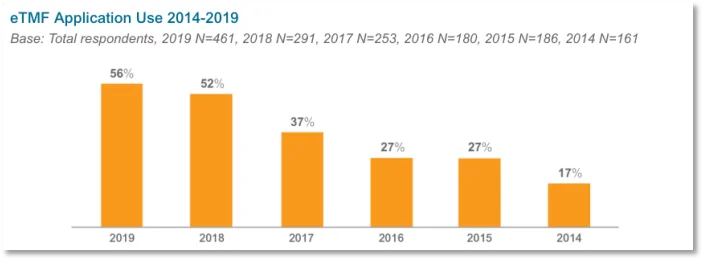
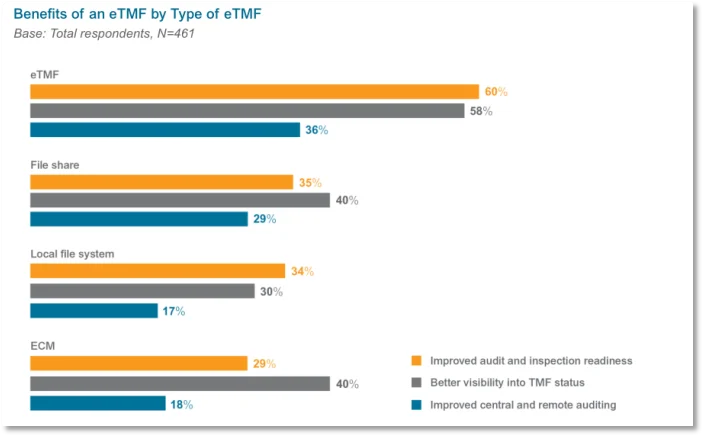
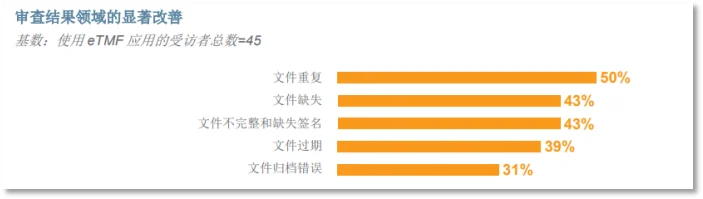
Drawing on Veeva's analyses of global clinical staff surveys on eTMF use published in 2016 and 2019, straightforward data comparisons show the upward trend in eTMF system adoption in recent years (Figure 1), a comparison of the advantages of different types of eTMFs in clinical trials (Figure 2), and the significant improvements eTMF systems bring to various record review issues (Figure 3).
Figure 1: Proportion of Survey Respondents Using an eTMF System, 2014–2019
Article illustration 
Figure 2: Comparison of the Advantages of Different eTMF Types in Clinical Trials
Article illustration
*Data source: Veeva 2019 Unified Clinical Operations Survey Report (gathering the experiences and opinions of 461 clinical professionals globally)

Figure 3: eTMF Systems Significantly Improve Various Record Review Issues
Article illustration 

*Data source: Veeva 2016 Paperless TMF Survey (gathering the experiences and opinions of 217 clinical professionals globally)


From the information above, compared with traditional approaches to collecting the TMF in clinical trials—both in the management advantages seen during the trial and in documentation improvements at final inspection—the year-over-year increase in eTMF system adoption shows that eTMF will inevitably become the prevailing trend in the future.


What makes it a clinical trial accelerator?

Search
Given that clinical trial projects span long timelines, involve complex document types in large volumes, and carry high document quality requirements, the following four aspects examine how an eTMF system helps accelerate overall trial progress:
01
Reducing labor costs

It significantly reduces labor costs and improves work efficiency. By using milestones to drive project document collection, and providing multidimensional reports and visual charts, teams can track filing progress across different studies and study sites in real time, reduce communication overhead across levels, and accelerate clinical trial workflows.

02

Convenient integrated workflows


Sponsors and study sites can leverage a more capable integrated platform to bring multiple clinical trial stakeholders together using a shared view, process, and system. Within the integrated platform, different roles can be managed and permissions configured, while strict approval workflows clearly define the primary person responsible at each workflow node—enabling smooth review, signing, and filing across roles to ensure comprehensive management of the trial master file.

03

Improving work efficiency through automation


Automated document naming and saving—based on mature TMF folder structures built by EClinCloud or customized to an organization's needs, files are automatically named, and this efficient, accurate filing approach can be applied to every study's document management to support content creation and collaboration across multiple documents.


First-round intelligent QC—built-in intelligent recognition tools automatically perform initial system-level checks for quality issues such as document legibility, blank pages, and duplicate content, improving document QC efficiency and ensuring document quality.

04

Accelerating the monitoring process


Equipped with strict permission controls and comprehensive audit trail logs, it effectively governs both internal and external access. All historical versions and action histories of each document can be retained, with support for multi-version management as well as viewing and downloading any historical version.


Why choose EClinCloud eTMF?

Search
Beyond the capabilities above, the EClinCloud eTMF system also offers convenient ways to operate and use the system, delivering a better user experience through the design of multiple functional modules.
Article illustration


Drag-and-drop files for easy upload


Saves documents in their original native format and supports automatic PDF conversion


Tracks and monitors document discrepancies to ensure completeness or legibility


Clearly manages user permissions, allowing control over each system user's "Download" and "Delete" actions


Finalized reports and documents in the CTMS system can automatically route to the appropriate folder in eTMF


Supports multi-time-zone and multilingual system modes, with built-in TMF collection structures aligned with multiple countries and regions


Automatically sends email reminders to clinical trial managers, clinical research associates, project managers, or other relevant clinical team members to complete tasks and reports


Tracks staff document filing and review completion statistics to support project management


Ensures that regulatory authorities or internal sponsor teams can conduct external reviews of study documents using the "validated, auditable" EClinCloud eTMF system


With a global footprint and international perspective, EClinCloud provides optimal trial master file management solutions for all types of clinical research stakeholders. As a pioneer in internationalized systems, EClinCloud has extensive experience running global projects, is familiar with TMF management regulations and folder structures across countries and regions, and deploys separate Tencent Cloud and Microsoft Azure servers domestically and internationally to ensure data isolation. By adopting a SaaS model, cloud instances remain independent and unshared, ensuring data security.

The EClinCloud team provides full-lifecycle services from system implementation and go-live to operations and maintenance, backed by a well-established service system and knowledge base. After go-live, dedicated project managers follow up to help clients resolve issues quickly and make clinical trial document collection and management more standardized, convenient, and efficient. If you are interested, please contact us through the channels below.


About EClinCloud

EClinCloud is a technology company focused on clinical R&D, offering an integrated, interconnected all-in-one clinical trial cloud platform (including technology products such as eCOA, CTMS, eTMF, EDC, and RTSM, and solutions such as scale management, linguistic validation, rater training, and data quality analysis) as well as clinical trial endpoint assessment technologies across therapeutic areas (including oncology, central nervous system, ophthalmology, and others). Combining cutting-edge technology with life-sciences data, it builds a globally leading "patient-centric" SaaS cloud platform supporting clinical evidence to help domestic and international pharmaceutical companies and research institutions improve R&D efficiency, accelerate the market launch of drugs and devices, and benefit countless patients.


Article illustration

Read the original WeChat article

Related reading

WeChat image 2026-11-11_150855_109.pngNews6 min readWorld COPD Day | Imaging Assessment in COPD Clinical ResearchNovember 13-15, 2026. November 18, 2026 marks the 25 World COPD Day, with this year's theme: Early Diagnosis and Management for a Better Life. Chronic Obstructive Pulmonary Disease (COPD) is a preventable and treatable disease characterized by persistent airflow limitation. COPD is closely related to chronic bronchitis and emphysema [1]. We have previously covered COAs for COPD,Article imageNews3 min readAddressing Complex Challenges in Clinical Research: EClinCloud’s Full-Lifecycle AI Enablement Attracts AttentionFrom November 13–15, the 2026 Nucleic Acid Therapy and Intelligent Biomedicine Industry Innovation Conference, academically guided by the Chinese Stroke Association and hosted by the Yuanshu Brain Science Research Center, was held in Fuzhou. Dr. Qin Long, founder and CEO of EClinCloud, was invited to deliver a keynote speech titled “Practice and Application of AI in Clinical Research,” sharing insights on the development trends of AI-enabled new drug R&D and the practice of AI throughout the clinical research process, which attracted enthusiastic attention from the attending guests. 01 Current Landscape of AI-Enabled New Drug R&D: AI is demonstrating application value in multiple segments of new drug R&D, including target discoverySAPA-China 2026 CNS Forum on-site photo 1News3 min readFocusing on CNS Clinical Endpoint Assessment: EClinCloud Shares eCOA and IRC PracticesAt the CNS Forum of the SAPA-China 2026 Pharmaceutical Industry Conference, Zheng Liangyan, Medical Director at EClinCloud, shared approaches to applying eCOA and IRC, covering challenges, regulatory requirements, and practical implementation in central nervous system (CNS) disease clinical research.