Cloud Review | "Expert Consensus on Intelligent Clinical Research"
Source: EClinCloud. Author: EClinCloud.

In recent years, with the rise of China's innovative drug R&D capabilities, China's accession to the ICH, and the official implementation of the revised Drug Administration Law and the updated GCP, national regulatory authorities have imposed increasingly stringent oversight on clinical trials. Faced with substantial project demand and strict quality requirements, traditional ways of conducting clinical research trials are no longer adequate, creating an urgent need to introduce digital and intelligent technologies to improve the quality and efficiency of clinical trials and drive leapfrog development in China's innovative pharmaceutical industry. However, in China, the adoption and prevalence of digital and intelligent clinical research remain limited, with gaps in experience and awareness as well as inconsistent standards and specifications.
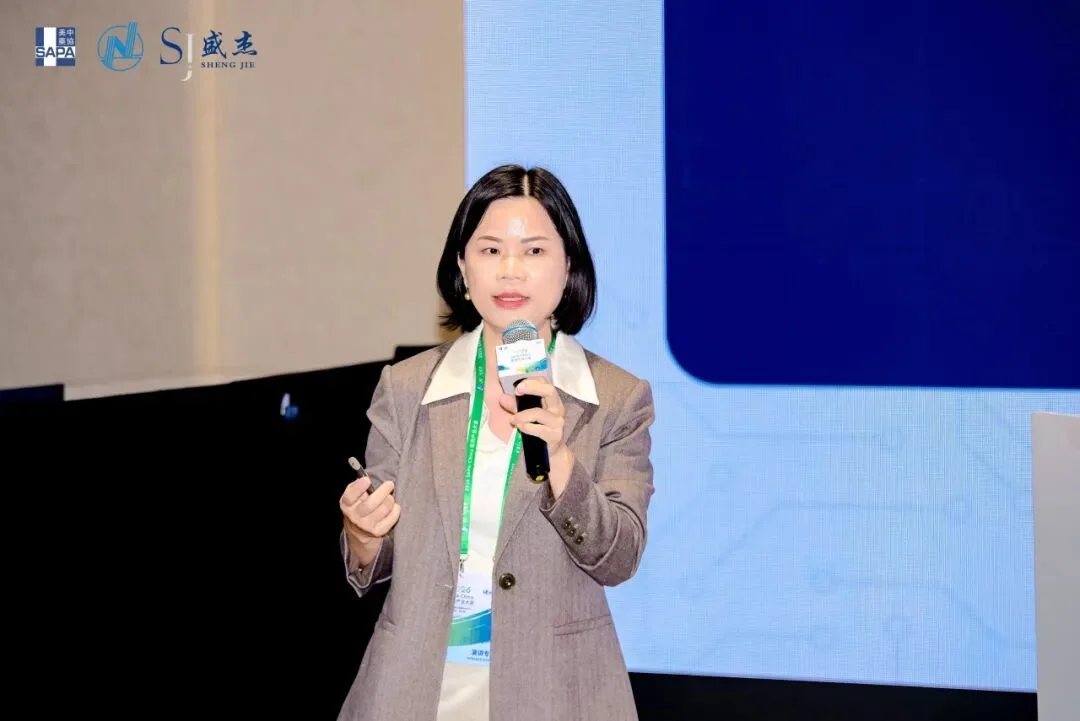
To promote the application of intelligent clinical research in China and provide a reference for its implementation and quality oversight, Dr. Qin Long, CEO of EClinCloud, serving as a member of the expert panel, joined experts from the Specialty Committee on Drug Clinical Research of the Shanghai Pharmaceutical Association, drug regulatory authorities, industry associations, research institutions, sponsors, and contract research organizations (CROs) to formulate the "Expert Consensus on Intelligent Clinical Research" (hereinafter referred to as the "Expert Consensus") for reference by the clinical research industry. The full text was officially published in the June 2020 issue of the "Chinese Journal of New Drugs and Clinical Remedies."

Keywords:
Intelligence
·
What does intelligent clinical research look like in practice, and what are its characteristics?
Click the blank area to reveal
Intelligent clinical research is a new participant-centric clinical research model that applies smart devices and remote communication technologies, encompassing integrated clinical research platforms, electronic informed consent, electronic health source data capture, direct-to-participant investigational product delivery, connected-device data monitoring, and community or home visits, among other elements. Building on digital information systems, intelligence utilizes new technologies such as big data, cloud computing, and artificial intelligence to achieve partial or end-to-end closed-loop management, oversight, and compliance control across clinical research workflows.
This model is characterized by improving participant accessibility and convenience, enhancing clinical research quality and efficiency, optimizing the allocation of medical resources, and reducing research costs.
Scroll up and down to view
Keywords:
Intelligent Systems
·
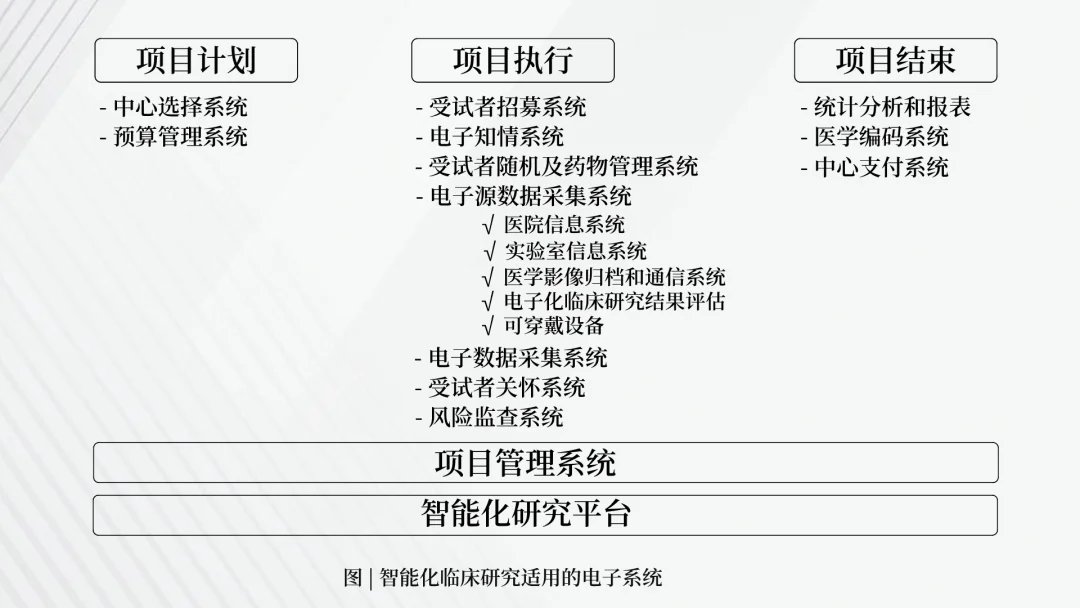
What specifically do intelligent clinical research systems include?
Click the blank area to reveal
Click to view full-size image
Keywords:
Application of Intelligent Systems
·
Innovative intelligent practices in patient recruitment and patient data capture
Click the blank area to reveal
Participant recruitment channels: Recruitment has expanded from relying solely on study sites to two sources: patient populations and referring physicians. On the patient side, recruitment channels can include big-data analysis of laboratory test results, publishing study information through electronic media easily accessible to target patients, or conducting education and outreach through patient associations.
Remote visits: In addition to routine telephone follow-up with participants, clinical researchers can use many different types of communication systems—such as instant messaging, telemedicine, or videoconferencing systems—to communicate with participants during a clinical study. Clinical researchers can record study-related information or data obtained during these communications in the participant's medical record.
Data management and statistical analysis: To address system fragmentation and information silos across various types of electronic source data, and to achieve cross-institutional, cross-regional, and cross-domain interoperability of clinical data resources for electronic source data, a unified clinical data standards system should be established before study implementation wherever possible to avoid additional data mapping work and improve data quality.
Scroll up or down to view
Keywords:
Intelligent Clinical Trial Protocol Design
·
What points should be considered when designing an intelligent clinical study protocol?
Click blank area to display
During protocol design, the applicability and application scenarios of intelligent technical tools should be fully considered, and selections should be made based on the clinical characteristics of the target indication.
Chronic diseases (such as diabetes and hypertension) have become one of the key therapeutic areas for implementing remote intelligent clinical research due to their high incidence, long disease course, poor treatment adherence, and relatively mature methods for collecting efficacy/safety data.
Rare diseases often have clinical study designs that can only be based on very limited prior research data, due to the lack of natural history studies on their pathogenesis and disease progression. However, remote intelligent data collection tools—such as electronic methods like ePRO systems and wearable devices—can expand the pool of participants, enrich clinical study data generation, and provide a more comprehensive basis for ultimately assessing the efficacy and safety of the investigational drug.
In oncology, clinical studies are numerous, recruitment is challenging, and follow-up periods are long, making the (partial) use of intelligent clinical research feasible—such as community or home follow-up for long-term safety and survival information. Study design should focus on the visit types for critical study procedures (such as imaging-based efficacy evaluations), and also consider whether oncology participants have a psychological dependence on "face-to-face medical care" as well as their core needs.
Scroll up or down to view
Cao Guoying (Huashan Hospital, Fudan University),
Fu Haijun (Shanghai Renzhi Data Technology Co., Ltd.),
He Wei (Pfizer (China) Research and Development Co., Ltd.),
Jiang Weiwei (Ruijin Hospital, Shanghai Jiao Tong University School of Medicine),
Li Huafang (Shanghai Mental Health Center),
Li Jin (Shanghai East Hospital, Tongji University),
Lin Feng (Shanghai Jiexin Pharmaceutical Technology Co., Ltd.),
Lu Jing (IQVIA Medical Technology (Shanghai) Co., Ltd.),
Ma Yan (IQVIA Medical Technology (Shanghai) Co., Ltd.),
Qin Long (EClinCloud (Shenzhen) Technology Co., Ltd.),
Ruan Xiufang (Drug Registration Division, Shanghai Municipal Medical Products Administration),
Shen Yifeng (Shanghai Mental Health Center),
Song Yi (Shanghai Jiexin Pharmaceutical Technology Co., Ltd.),
Wang Fangmin (Shanghai Center for Drug Evaluation and Inspection),
Wu Rong (Huashan Hospital, Fudan University),
Xu Ying (Shanghai Center for Drug Evaluation and Inspection),
Yuan Weian (Shuguang Hospital, Shanghai University of Traditional Chinese Medicine),
Zhang Jing (Huashan Hospital, Fudan University),
Zhang Ruiwen (Shanghai Biomedical Industry Science and Technology Promotion Center),
Zhang Xiaomin (Shanghai Pharmaceutical Association)
Press and hold to scan the QR code to view the full "Expert Consensus on Intelligent Clinical Research."
| EClinCloud |
EClinCloud provides an integrated, all-in-one cloud platform (including solutions such as CTMS, eTMF, EDC, RTSM, eCOA, and eConsent, as well as consulting services such as scale management, linguistic validation, rater training, study build and configuration, and data quality analysis) and clinical trial endpoint assessment technologies across therapeutic areas (including oncology, neurology, cardiology, pulmonology, dermatology, and others). Combining cutting-edge technology with life data, EClinCloud is building a globally leading "patient-centered" SaaS cloud platform for clinical evidence support to help domestic and international pharmaceutical companies and research institutions improve R&D efficiency, accelerate the launch of drugs/medical devices, and benefit countless patients.