Clinical Trials Face a Major Test Amid COVID-19: How Overseas Investigators and Sponsors Are Preparing
Source: EClinCloud. Author: EClinCloud.

On April 27, Shanghai held a press conference on COVID-19 prevention and control to share the latest updates on epidemic control.
Since Shanghai launched its zero-COVID campaign, the results have become increasingly evident.
As the number of new local COVID-19 infections in Shanghai declines substantially, controlling the case fatality rate will become the top priority of near-term epidemic response efforts.
According to a report by Sanlian Lifeweek, from April 17 to April 23 alone, Shanghai reported 87 new local deaths, predominantly among older adults. In addition to having severe underlying conditions, these deceased patients shared another characteristic: only a very small number had been vaccinated.
Currently, vaccination remains the most effective means of preventing COVID-19.


So how is a vaccine developed?
Historically, creating a vaccine requires passing stage after stage of evaluation—from initial development, animal studies, and multiple phases of clinical trials to marketing applications and real-world studies—often taking years or even decades before it can finally be put into use.
In total, five steps are required before a vaccine can be put into use: R&D → registration → manufacturing → distribution → use.
The R&D stage alone takes an extraordinarily long time; the entire process from initial strain selection and process stability testing through the completion of clinical studies is called the R&D stage. Specifically, it is divided into laboratory development, preclinical studies, and clinical trials.
Among these, clinical trials are divided into four study phases—Phase I, II, III, and IV. Only after Phase IV clinical trials conclude with expected clinical protective efficacy and a favorable safety profile can a company submit its clinical data to the Center for Drug Evaluation (CDE) of the China Food and Drug Administration to apply for registration and manufacturing approval. The entire clinical trial timeline generally takes at least 3–6 years, and can even span more than a decade.
Aside from COVID-19–related drug R&D, all other drug R&D entered "sleep mode"
Drug R&D normally takes a very long time, yet COVID-19 vaccines arrived at lightning speed. All of this was thanks to national policy support, concerted collaboration among investigators across countries, and prior research on coronaviruses, among other factors. However, other drug R&D programs have not been able to receive the same level of support.
With COVID-19 raging, scientific research paused amid the storm.
When the COVID-19 pandemic struck in 2020, the clinical trials field also suffered a heavy blow—universities closed their doors, and hospitals shifted their focus to responding to COVID-19. Many clinical trials requiring multiple follow-up visits with participants were forced to be postponed or terminated. The COVID-19 pandemic affected R&D progress across clinical trials as a whole.
According to a study from a prominent specialty hospital in Beijing, from February to July 2020, 202 drug clinical trial projects at the hospital were forced to stall due to the pandemic, accounting for approximately 31% of all ongoing drug trial projects.
A report by the National Center for Biotechnology Information (NCBI) noted that from January 1 to May 31, 2020, on the U.S. clinical trials database (ClinicalTrials.gov), nearly 6000 registered clinical trials were terminated—roughly twice the number prior to the outbreak.
So how can we respond to this "major test for clinical trials"?
To keep their studies moving forward, some overseas scientists creatively completed trials by mailing medications to trial participants, conducting video visits, and having participants self-monitor at home.
Neurologists at Massachusetts General Hospital modified an early-stage study of Ritalin (a central nervous system stimulant) so that participants no longer needed to visit the hospital every two weeks and could instead receive their medication by mail at home. Investigators could assess participants' cognitive status via videoconference, and participants used computers to play brain games to complete routine testing at home.
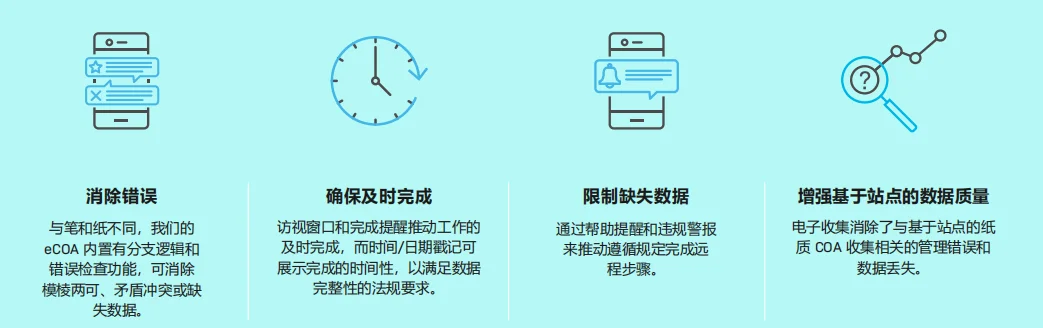
Many investigators, when facing this "major test for clinical trials," also chose a smarter tool. Using this tool, direct feedback from participants can be collected remotely, allowing participants to send their symptoms and how they are feeling directly to researchers on a mobile device without leaving home, and that smart tool is eCOA.
As acceptance among investigators and patients grows, more and more sponsors are choosing to use eCOA in their clinical studies to capture source data more directly, accurately, and promptly—benefiting from higher data quality, more efficient study management, a better patient reporting experience, and greater cost savings.

EClinCloud provides an integrated all-in-one cloud platform (including solutions such as CTMS, eTMF, EDC, RTSM, eCOA, and eConsent, as well as consulting services such as scale management, linguistic validation, rater training, study build and configuration, and data quality analysis) and clinical trial endpoint assessment technologies across therapeutic areas (including oncology, neurology, cardiology, pulmonology, dermatology, and others). By combining cutting-edge technology with life sciences data, it builds a globally leading, "patient-centric" SaaS cloud platform for clinical evidence support, helping domestic and international pharmaceutical companies and research institutions improve R&D efficiency, accelerate the launch of drugs and medical devices, and benefit countless patients.
Scan QR code
Learn more about EClinCloud products