Source: EClinCloud. Author: eClinCloud.
Click the blue text above to follow us
From August 24 to 27, 2021, the "Training Series on Clinical Research Technologies and Capacity Building for Psychiatric and Psychological Disorders" was successfully held. Dr. Qin Long, CEO of EClinCloud, was invited to deliver a keynote presentation titled "New Scale Assessment Technologies in Psychiatric and Psychological Clinical Research." He provided a comprehensive overview of three new technologies currently used in scale assessment—namely eCOA, rater training, and blinded data analytics—and shared case examples demonstrating how these new technologies help clinical research.
We will introduce these three new technologies in a series of three articles; this article covers Part 3: blinded data analytics.

Blinded Data Analytics (BDA) is a new data analytics technology that uses centralized statistical monitoring under blinded conditions to promptly identify and correct data quality issues that could affect study endpoints. Risk-Based Monitoring (RBM), by contrast, covers the entire clinical research process; from a data perspective, BDA should be viewed as a complement to RBM, because it focuses exclusively on clinical endpoint data quality.
Factors Leading to Data Quality Issues
In clinical trials, data quality can be challenged across many aspects, and multiple factors can lead to data quality issues.
Many scales used as primary endpoints in clinical trials rely on the rater's subjective diagnosis, and diagnostic accuracy affects data quality; second, whether subject enrollment strictly follows the inclusion criteria; and bias in outcome measurement. Although each may be a small bias on its own, their cumulative effect can ultimately produce a large bias in the results.
Long-term changes in symptoms; diurnal variations, where daytime and nighttime data sometimes differ; and environmental changes, which can also cause symptoms to differ. All of these factors contribute to the ultimate instability of the data.
Differences in the regions where subjects are located can also lead to significant variations in the data.
During a clinical trial, raters and subjects may introduce bias in efficacy and safety evaluations, selective enrollment, or the determination of analysis populations, and may even affect the accuracy of the clinical trial results.
Differences in trial size and complexity, as well as differences in randomization and blinding, are all factors that affect data quality.
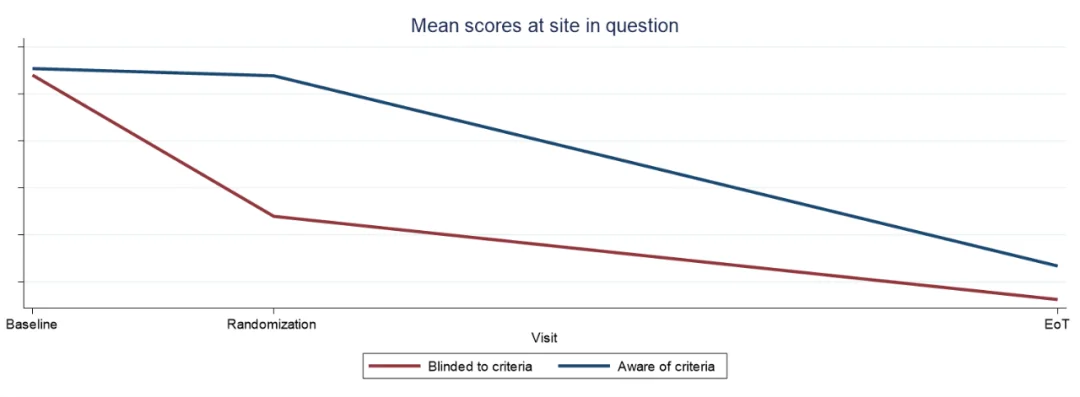
The figure above shows findings from a real project. In this trial, there was a large difference between the mean scores at study sites blinded to the randomization criteria (red line in the figure) and those at study sites unblinded to the randomization criteria (blue line in the figure). Therefore, depending on the project, study design must carefully consider whether to conduct the trial using blinded randomization criteria.
Intentional Data Fabrication
Intentional data fabrication is generally the least common factor. It may have occurred more often in the past, but today, with growing awareness, stricter regulatory oversight, and more available tools, clinical trials have become increasingly rigorous and standardized, and the likelihood of fabrication has become smaller and smaller.
Parkinson's specialists know that Parkinson's disease typically begins unilaterally, affecting only one side of the body. Over time, the disease progresses to bilateral involvement, affecting both sides of the body; at that stage, one side is often more severely affected than the other, which is a characteristic feature of Parkinson's disease.
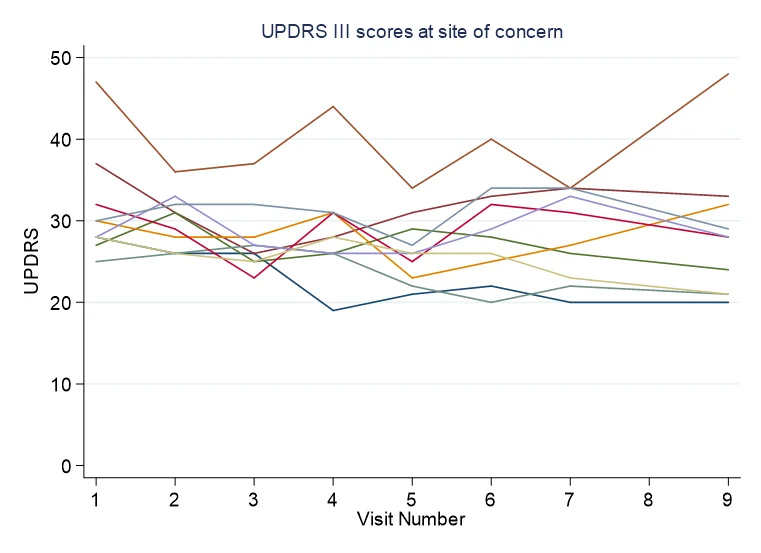
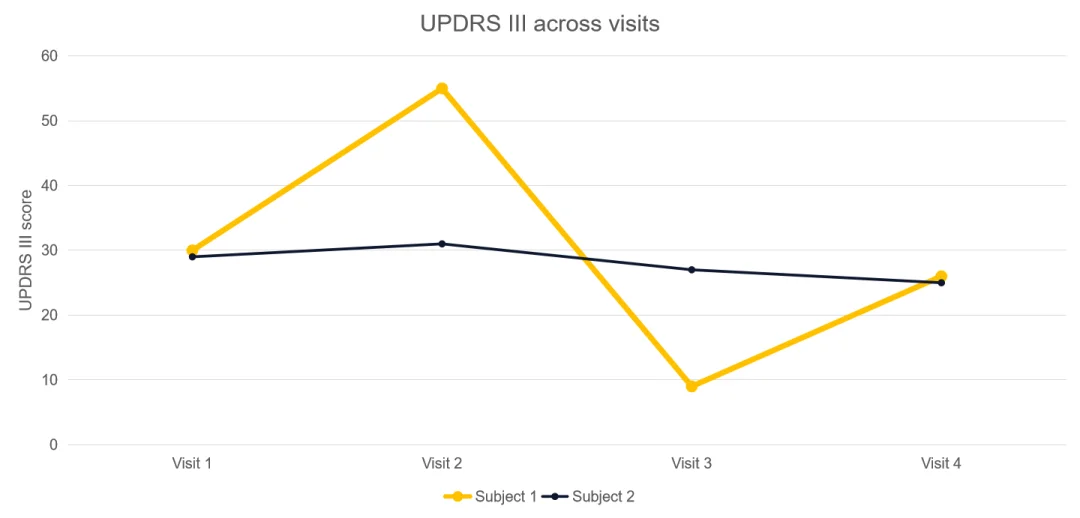
The chart above shows scoring results from a standard Parkinson's disease rating scale. It displays mean scores across different visits—that is, the combined average of the left and right sides—with each line representing one patient. From the chart alone, no issues are apparent, and total-score analysis did not reveal any abnormalities either.
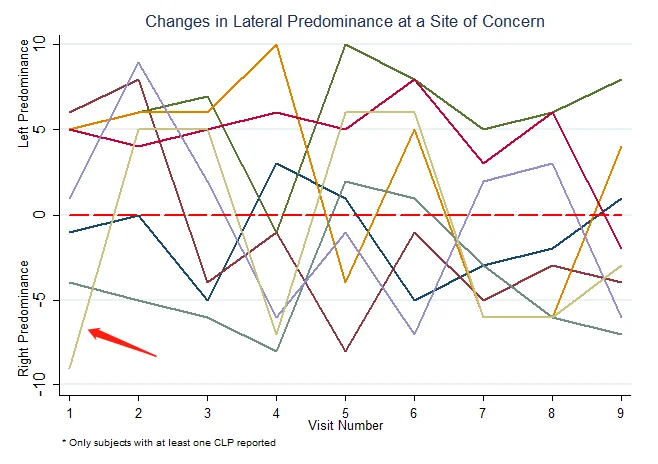
However, instead of simply looking at the overall UPDRS score, if we break the scores apart and analyze them from another angle—looking at changes in the left- and right-side data—we can see where the problem lies. Take this light green line (indicated by the red arrow in the figure): it fluctuates up and down, with symptoms appearing more severe on the left side at one time and more severe on the right side at another. From the perspective of the symptoms themselves, this is problematic data, because we know that in Parkinson's disease, one side remains more severely affected than the other over the long term. Data issues like this cannot be seen simply from a single dimension; a different analytical approach is needed to uncover these hidden data problems.
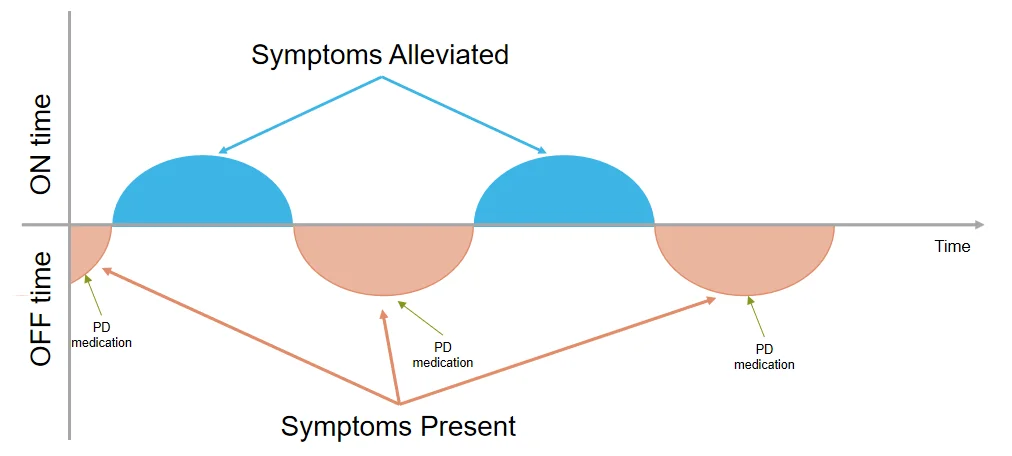
After patients with Parkinson's disease take medication, there is a period during which the medication is effective and symptoms are relieved, known as ON time. Once the medication wears off and symptoms return, that period is called OFF time. After taking medication, patients with Parkinson's disease experience symptom relief for a period, return to their previous state when the effect wears off, and then take medication again to gain relief—a cycle that patients go through.
Looking at the data for the two patients in the chart above in light of this characteristic, Patient 1 (yellow) shows a sudden spike in score at Visit 2 and a sudden drop at Visit 3, whereas Patient 2 (black) has relatively stable scores.
What caused such large fluctuations in the scoring data? The most likely reason is a failure to follow the protocol strictly, resulting in inconsistent assessment timing. At Visit 2, the high score may have occurred because the patient was already in OFF time rather than ON time. Selecting the wrong time window caused the data to fluctuate up and down, leading to unstable outcome data. The study site later disclosed that the rater indeed had not performed the assessment based on the elapsed time after the patient took the medication, but rather whenever the rater was available. By the time the rater was free, the medication's effect had sometimes already worn off and at other times was still active, which naturally caused the scores to swing up and down.
In clinical trials, data quality is the foundation for evaluating trial results, and authentic, reliable data are essential for bringing a drug to market. Early detection of data quality issues is therefore critical so that timely corrections can be made to ensure data quality.
By defining a suite of intelligent algorithms, we examine study data across multiple levels—rater level, study-site level, country level, regional level, and study level—to identify potential data issues in near real time. The algorithms are therefore critical: setting them up properly requires not only statistical expertise, but also clinical, disease-specific, and scale-specific knowledge. Once issues are found, we intervene to correct them using the right methods. At the same time, trend analysis is conducted for prevention. Finally, we can select raters or study sites with strong or poor historical performance—for example, identifying which raters perform better and which study sites deliver higher quality.
Identify data issues in clinical trials through BDA
Take timely corrective actions
Help us optimize clinical endpoint data
Minimize bias as much as possible
Improve the consistency and validity of results
EClinCloud brings effective treatments to patients through innovative, "patient-centric" remote intelligent solutions. We provide an integrated, all-in-one cloud platform (including solutions such as CTMS, EDC, eTMF, eCOA, eConsent, and RTSM, as well as consulting services such as scale management, linguistic validation, and study design) along with clinical trial endpoint assessment technologies across therapeutic areas (oncology, neurology, cardiology, pulmonology, dermatology, and more). Combining cutting-edge technology with life data, we build a globally leading "patient-centric" SaaS cloud platform supporting clinical evidence, helping domestic and international pharmaceutical companies and research institutions improve R&D efficiency, accelerate the market launch of drugs and devices, and benefit countless patients.
Read the original WeChat post