CDE Releases New PRO Guideline: What Are the Special Requirements?
Source: EClinCloud. Author: EClinCloud.
Pediatric new drug development spans multiple areas, including dermatology, respiratory, immunology, neurology, and rare diseases. As more therapies enter pediatric clinical research, how to comprehensively evaluate treatment effects has become an area of focus in study design.
In November 2026, CDE issued the "Technical Guidelines for the Application of Patient-Reported Outcomes (PRO) in Pediatric Drug Clinical Trials," providing guidance on the selection and use of PROs in pediatric drug clinical trials and serving as a reference for study design and conduct.
Click "Read Original" at the end of the article to download the document.

Special Considerations and Basic Principles for Pediatric PRO Use
Pediatric PRO use cannot simply replicate adult models.
Compared with adults, children are still developing in terms of cognition, information comprehension, and language expression, and substantial differences also exist across pediatric age groups.
The guideline states that the application of PROs in pediatric drug clinical trials should follow four basic principles.
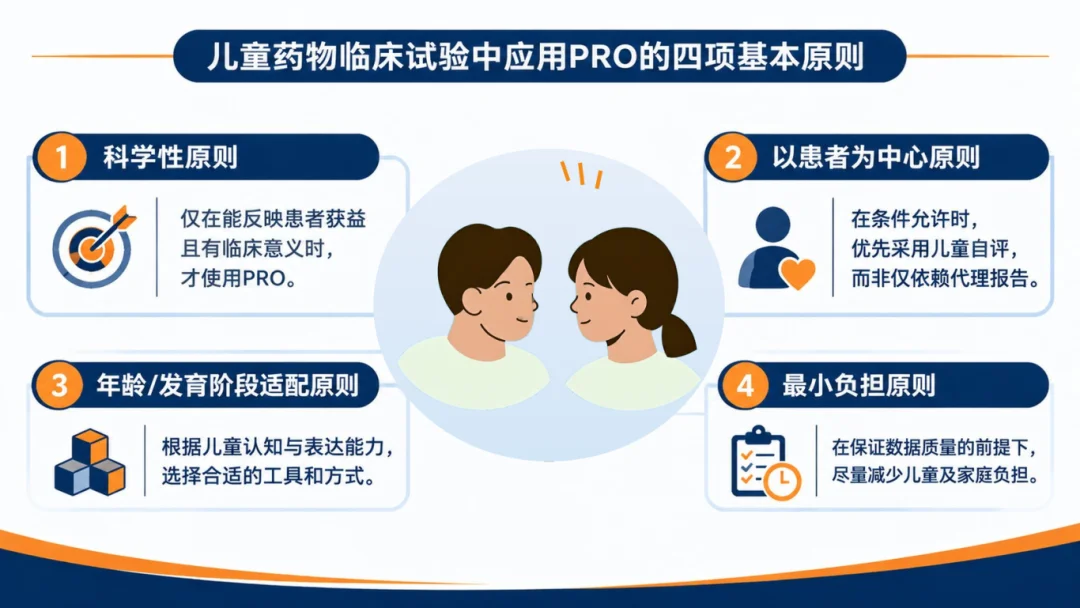

Accordingly, assessments must ensure scientific validity and clinical meaningfulness while accounting for children's actual comprehension and participation experience—maintaining data validity without imposing unnecessary burden on children and their families.
This is a central emphasis of the guideline: pediatric PROs must not only measure accurately, but also be comprehensible to children, suitable for their participation, and feasible to implement consistently in clinical trials.

Key Requirements for Implementing Pediatric PROs
In addition, because children have distinct characteristics in cognition, attention, and compliance, PRO data are susceptible to factors such as the respondent, assessment environment, and age differences. Therefore, beyond selecting an appropriate instrument, standardized procedures must be established across data collection, operational management, and statistical analysis to minimize measurement bias and data variability as much as possible and improve the reliability of study results.
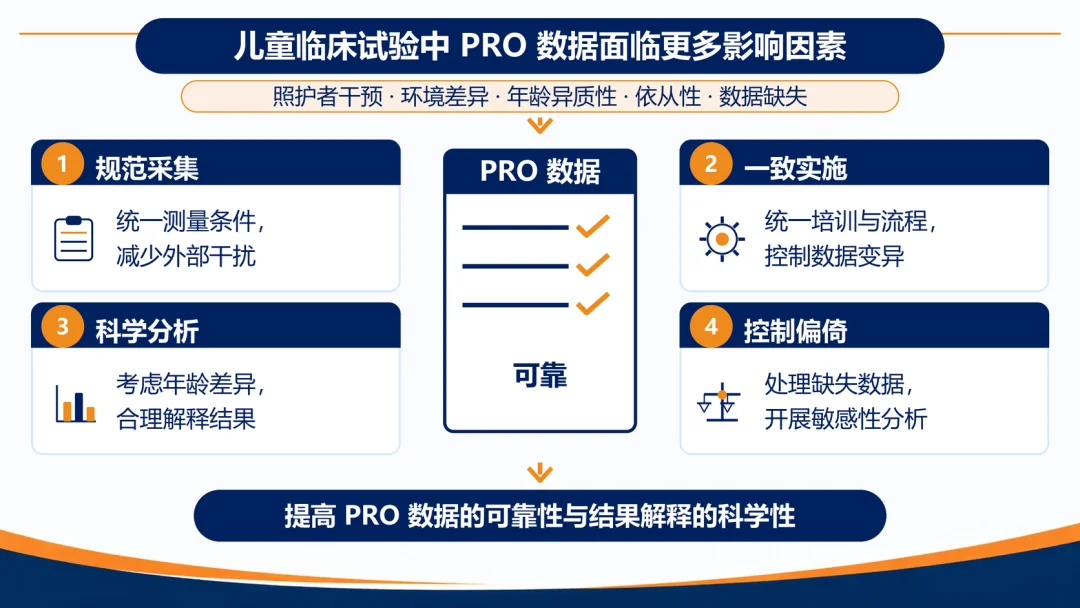
Studies need to consider not only whether data are collected completely, but also whether the data generation process is standardized, whether data from different sources are comparable, and whether the final analysis appropriately reflects children's actual experience.
At the same time, data quality management for pediatric PROs should span the entire process of study conduct and statistical analysis, rather than relying solely on post-trial data checks.
Support Provided by ePRO
The guideline includes a dedicated section on "Electronic PRO (ePRO) and Novel Measurement Methods," clarifying the value and relevant considerations of electronic tools in pediatric clinical trials.
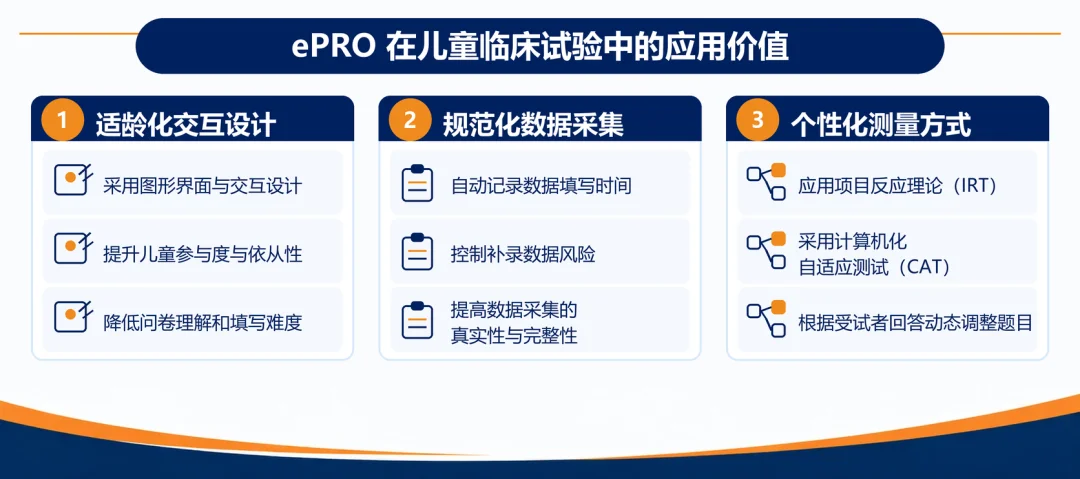
Electronic measurement opens up greater possibilities for pediatric PRO applications.
With more intuitive interactions and flexible measurement approaches, ePRO can help reduce the difficulty for children participating in assessments to some extent and improve standardization in data collection.
The guideline also emphasizes that when applying ePRO and novel measurement methods, their suitability in the target pediatric population must be thoroughly validated, taking into account factors such as children's cognitive abilities, the usage environment, device accessibility, and caregivers' ability to use them.
The EClinCloud eCOA solution supports multiple electronic clinical outcome assessment (eCOA) modalities—including ePRO, eClinRO, eObsRO, and ePerfO—using electronic data capture, user-centered interaction design, and standardized workflow management to improve endpoint assessment data collection efficiency and user experience in clinical studies, while safeguarding data integrity, accuracy, and traceability through comprehensive data quality control mechanisms.
Backed by an integrated solution covering scale copyright management and rater training, EClinCloud has accumulated extensive practical experience across multiple pediatric clinical studies in dermatology, neurology, ophthalmology, respiratory, and other therapeutic areas.
EClinCloud is a leading AI company in the clinical research industry, building an AI-driven integrated intelligent clinical cloud platform and endpoint assessment technology to provide global pharmaceutical companies and research institutions with technology products such as eCOA, CTMS, eTMF, EDC, RTSM, IRC, and RM, alongside scale management, linguistic validation, rater training, and data quality analysis services to deliver efficient, precise digital solutions, and relying on AI predictive models and an intelligent data platform to dynamically assess and help improve drug clinical trial success rates, helping shorten drug and device R&D cycles and benefit patients.