The Hidden Cost of Clinical Research Lies in the Gaps Between Systems
Source: EClinCloud. Author: EClinCloud.
In August 2026, ACRP (Association of Clinical Research Professionals) published a feature article, "Death by a Thousand Portals," examining technology fragmentation in clinical research[1].
The article cites 2023 Advarra survey data:
◆ Nearly 70% of study sites reported managing 6 or more login accounts per study;
◆ 55% of study sites rated sponsor-provided technology system setup and training as "very burdensome" or "extremely burdensome";
◆ 67% of study sites reported that this technology burden had increased compared with five years earlier.
The more digital tools are adopted, the heavier the burden becomes. What clinical research truly needs is not more systems, but better connectivity, which is why "integration" is critical.

Data and People in Silos
◆ On the data side: Systems operate independently, and workflows and data are not interoperable, creating information silos that make efficiency and quality difficult to ensure.
◆ On the human side: Study teams navigate multiple systems, accounts, and interfaces, creating a daily burden of lost time and duplicated work.
Without Connectivity, There Is No True AI
The upper limit of AI's capabilities depends to a certain extent on the data foundation and operational connectivity. Bringing AI into clinical research is not about adding one more AI assistant or agent; it requires first having a foundation that connects data, workflows, and operational scenarios.
Integration is therefore no longer just about "fewer logins and less data entry"—it has become a prerequisite for deploying AI and enabling data to generate value.
Evolving Regulation: From Electronic Records to End-to-End Governance
ICH E6(R3) and the updated GCP reinforce Quality by Design, risk-proportionate approaches, and fitness-for-purpose principles while emphasizing data traceability, shifting quality management toward continuous, proactive, risk-based data governance. When regulatory oversight focuses on the entire process, cross-system data connectivity and an end-to-end view become even more necessary.
A collection of products ≠ integration.
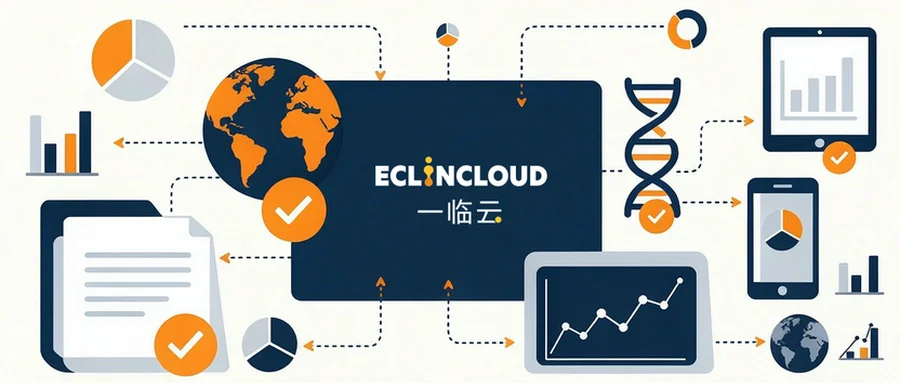
It cannot simply be understood as placing products such as EDC, RTSM, CTMS, and eTMF on the same platform. True integration should shift from a "product perspective" back to an "operational perspective."
Therefore, what an integrated platform truly needs to connect is not just systems, but workflows, data, roles, and AI capabilities.
It moves away from completing different tasks across separate systems toward conducting the entire study around a single clinical trial in a unified operational environment—ultimately forming an intelligent, collaborative clinical research environment centered on data, structured around operational workflows, and powered by AI.
Unified entry point: CRAs, CRCs, PMs, medical, data management, QA, and management roles collaborate on the same platform according to their permissions, eliminating system switching, repeated logins, and searching for information.
◆ Shorter cycle times: Automate workflows and reduce duplicated work to significantly shorten the time from startup to completion.
◆ Lower costs and higher efficiency: Reduce maintenance expenses across multiple systems and platforms, improve staff efficiency, and reduce rework and delays.
Across the full study lifecycle—protocol design → site startup → recruitment and enrollment → randomization and drug supply → data capture and follow-up → monitoring and risk management → data cleaning → statistical analysis → reporting and closeout, and more—data is entered once and shared in real time, linked across stages, and traceable end to end.
The platform not only synchronizes data in real time across internal systems, but also supports API integration with external data sources and third-party systems to fit into the sponsor's existing technology ecosystem.
Visibility: From partial data to a holistic view
Once operational data is genuinely connected, managers no longer see only partial information from a single system, but the overall status of the trial: progress, data quality, site performance, risks, documents, and key metrics. Project management evolves from "information aggregation" to "holistic decision-making."
Through mechanisms such as source data capture, real-time alerts, and audit trails, it improves data accuracy, completeness, and consistency to meet regulatory requirements.
Built on connected data and workflows, AI can be used for intelligent protocol parsing, document and report processing, risk identification, and intelligent insights. With automated workflows handling repetitive tasks, teams can focus on high-value work while receiving decision support to accelerate R&D.
An integrated approach delivers overall improvements in efficiency, quality, and experience:
Organizations reduce costs and improve efficiency, teams lighten their workload and stay focused, study sites and investigators work more conveniently, trial participants have a better participation experience through eCOA and remote data collection, and clinical research itself achieves shorter timelines, higher quality, and more controllable risks.

Contact us to learn more
[1] ACRP. Death by a Thousand Portals: Addressing Technology Fragmentation and Site Burden in Clinical Research. August 2026. https://acrpnet.org/2026/08/11/death-by-a-thousand-portals-addressing-technology-fragmentation-and-site-burden-in-clinical-research
EClinCloud is a leading AI company in the clinical research industry. Driven by AI, it builds an integrated intelligent clinical cloud platform and endpoint assessment technologies, providing global pharmaceutical companies and research institutions with technology products including eCOA, CTMS, eTMF, EDC, RTSM, IRC, and RM, along with scale management, linguistic validation, rater training, and data quality analysis services to deliver efficient and accurate digital solutions. Leveraging AI predictive models and an intelligent data platform, it dynamically assesses and helps improve the success rate of drug clinical trials, helping shorten drug/device R&D cycles to benefit patients.