Source: EClinCloud. Author: EClinCloud.
Hello everyone, it has been a while. In our previous post, we looked at the scales used for routine diagnostic assessment of COPD (click here to review the previous post). In this post, we continue by exploring the COPD scales used in clinical trials.

In clinical treatment studies of chronic obstructive pulmonary disease (COPD), whether a treatment improves patient symptoms and quality of life is also an important part of the evaluation, and scale assessments can serve as efficacy endpoints to measure the impact of treatment.
So...
Which COPD scales are most commonly used in clinical trials, and what is each used for?
01 Assessing Subject Health Status
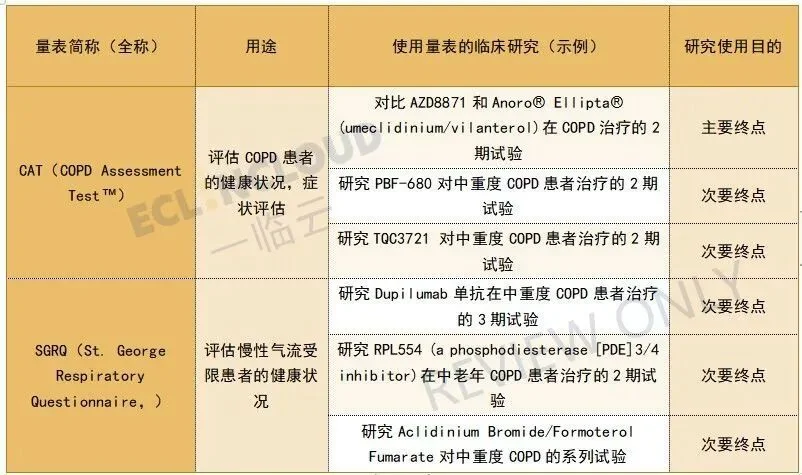
As mentioned in our previous post, both the CAT and the St. George's Respiratory Questionnaire (SGRQ) are patient-reported outcome (PRO) scales commonly used in clinical trials to assess patients' health status and quality of life, and they are frequently used in secondary endpoint assessment for treatment studies in patients with moderate-to-severe COPD.
How the Two Compare
Unlike the CAT, the SGRQ consists of 50 items, has good discriminative and evaluative properties, demonstrates good responsiveness in treatment studies, has been validated in both asthma and COPD, and has yielded disease-specific derivative versions such as the SGRQ-C for COPD. The SGRQ takes 8–15 minutes to complete, making it more suitable for clinical trial research.
02 Assessing Dyspnea Symptoms
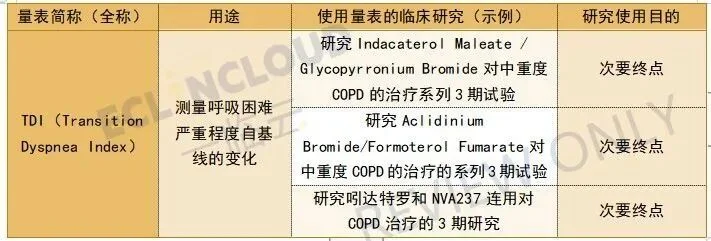
Scales used to assess COPD dyspnea in clinical trials include the Transition Dyspnea Index (TDI). The TDI is commonly used together with the Baseline Dyspnea Index (BDI) to measure the degree of change from baseline dyspnea across three domains: functional impairment, activity level, and effort required to perform activities.
For the 3 domains assessed by the TDI, scores range from -3 (most severe deterioration) through 0 to +3 (greatest improvement), with a total score from −9 to +9; the lower the score, the greater the worsening of dyspnea.
Another commonly used scale is the Borg CR10 Scale, a simple rating scale often used together with the 6-minute walk test to assess dyspnea during exercise.
03 Assessing Acute Exacerbations of COPD
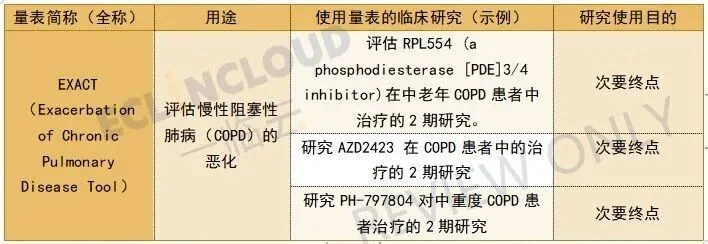
Exacerbation of Chronic Pulmonary Disease Tool (EXACT) is a PRO that monitors the early stages of acute COPD exacerbations and is an effective method for assessing the severity of acute exacerbations, so it is frequently used in related therapeutic studies. The EXACT-derived scale, EXACT-Respiratory Symptoms (E-RS), consists of a subset of EXACT items and is used to evaluate the effect of treatment on respiratory symptom severity in stable COPD.
Selecting an appropriate assessment tool in clinical practice is very helpful for evaluating disease status and guiding clinical treatment.
If you have any needs or questions regarding scale usage, please feel free to contact us. The EClinCloud team looks forward to your inquiry.
EClinCloud is a technology company focused on clinical R&D that provides an integrated, interconnected all-in-one clinical trial cloud platform (including solutions such as scale design, scale copyright management, linguistic validation, rater training, and data quality analysis across technology products and solutions including eCOA, CTMS, eTMF, EDC, RTSM, and RM) as well as clinical trial endpoint assessment technologies across different therapeutic areas (including central nervous system and ophthalmology, among others). By combining cutting-edge technology with life data, it builds a globally leading "patient-centric" SaaS cloud platform supporting clinical evidence to help domestic and international pharmaceutical companies and research institutions improve R&D efficiency, accelerate the market launch of drugs and medical devices, and benefit countless patients.

Read the original WeChat post