Regulatory Brief | Neuropathic Pain Clinical Trials to Receive Formal Technical Guidance

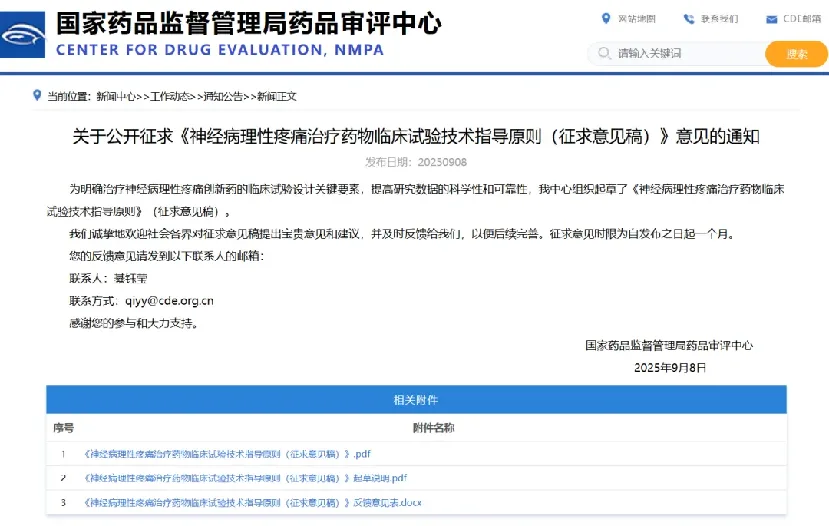
On September 8, 2025, the Center for Drug Evaluation (CDE) issued a notice seeking public comment on the "Technical Guidelines for Clinical Trials of Drugs for Neuropathic Pain (Draft for Comment)." This marks an initial effort in China to issue systematic guidance in this field.
Background
Neuropathic pain (NP) is chronic pain caused by a lesion or disease affecting the somatosensory nervous system, often manifesting as burning pain or electric-shock-like pain and severely affecting patients' quality of life.
Domestic and international developments:
The United States and Europe have successively issued relevant development guidelines, and several new drugs have been approved; clinical need in China is urgent, yet systematic guidance documents were previously lacking.
Purpose of issuance:
To improve R&D efficiency and quality by establishing technical guidelines, and in particular to provide reference recommendations on Phase III clinical trial design elements.
Interpretation of key points
1. R&D Principles
Guided by clinical needs, ensure that drug development meets the core objective of benefit-risk assessment.
Full drug lifecycle management is encouraged, including indication expansion, formulation optimization, etc.
2. Key Design Elements for Phase III Trials
Overall trial design: randomized, double-blind, placebo-controlled
for ≥12 weeks; peripheral NP (PHN, DPNP) and central NP must be confirmed separately.
Inclusion and exclusion criteria: Trial participants must have a pain duration of
≥3 months and a pain score of at least moderate severity (VAS ≥40 mm or NRS ≥4 points).
Efficacy endpoints: The core endpoint is the weekly average daily pain score (ADPS), while multidimensional scales and scales assessing concomitant symptoms and quality of life should also be included.
Multidimensional pain scales: for example, the Short-Form McGill Pain Questionnaire (SF-MPQ), Neuropathic Pain Scale (NPS), and Neuropathic Pain Symptom Inventory (NPSI);
Concomitant symptom and quality-of-life scales: sleep interference (ADSIS, MOS-SS), emotional state (HADS), quality of life (SF-36, EQ-5D-5L), and Patient Global Impression of Change (PGIC).
Safety requirements: focus on central nervous system side effects and abuse risk; compliance with ICH E1 long-term exposure requirements is required.
3. Other considerations
Data extrapolation: dose exploration can be extrapolated across different disease models.
Active control: pregabalin may be considered as a reference drug.
Special populations: Trials in older adults need to consider age-friendly design; research evidence in pediatric populations is limited, and exploration is recommended
starting from ≥12 years of age.
As can also be seen from this document, scales are at the core of the evaluation system for neuropathic pain clinical trials, and using scientific, rigorous, and standardized scale instruments can safeguard the reliability of trial data.
EClinCloud has accumulated extensive scale-service experience across multiple therapeutic areas, including pain and CNS, providing one-stop services covering scales, rater training, and eCOA systems to deliver scientific, professional support for sponsor study scale selection and rater training. Inquiries are welcome.