CDE's Latest Technical Guidance for AD Drug Clinical Trials: Key Changes Explained


In May 2025, CDE issued the "Technical Guidance for Clinical Trials of Drugs for Alzheimer's Disease (Trial)," revising and adjusting the draft for comment released in September of the previous year and setting forth new technical requirements for Alzheimer's disease (AD) drug development.
We analyzed and compared the two guidance documents. Let's take a look at the adjustments.
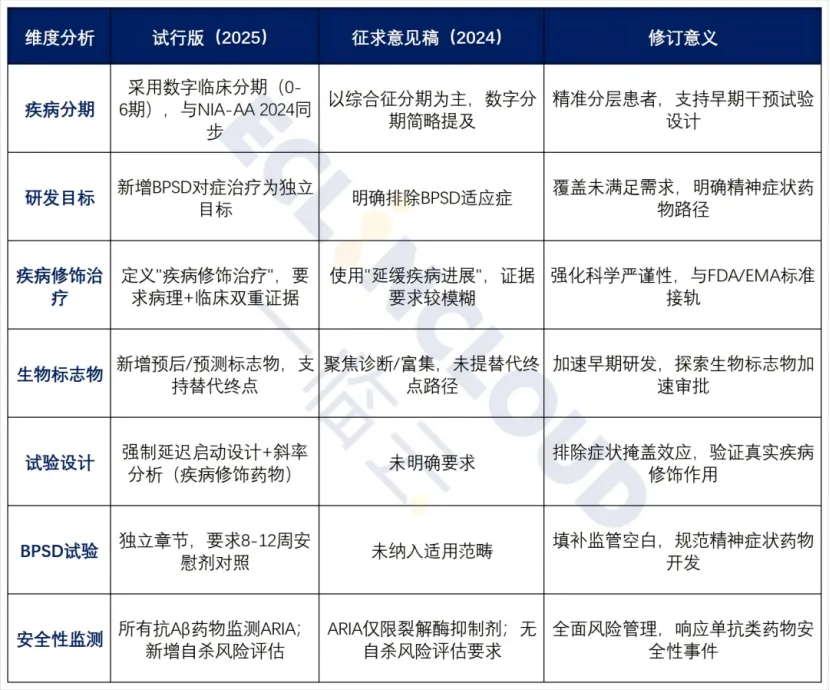
In addition, we found notable differences in the updated table of contents, with the addition of
two major sections: "Key Technical Considerations" and "Statistical Considerations." At the same time, "Efficacy Assessment Tools" has been incorporated into the "Key Technical Considerations" section, reflecting the emphasis placed on it.

"Scales are one of the commonly used tools for efficacy evaluation in Alzheimer's disease."
The guideline lists examples used in some previous clinical trials across multiple areas—including cognitive function testing, daily functioning, global efficacy assessment, and composite assessment of cognition and daily functioning—and updates the content from the trial version:
Cognitive function testing:
ADAS-cog has been widely used in Alzheimer's disease studies of mild to moderate dementia; attention should be paid to its ceiling and floor effects (descriptions of specific versions deleted)
Daily functioning:
ADCS-ADL is a daily functioning assessment scale widely used in clinical trials of patients with mild to moderate Alzheimer's disease (unchanged)
Global efficacy assessment:
CIBIC-plus can evaluate the overall clinical status of patients with dementia relative to baseline; ADCS-CGIC is another semi-structured interview based on global information from patients and their caregivers (comparison between the two deleted)
Composite assessment of cognition and daily functioning:
CDR-SB is a composite assessment scale that can assess changes across both the cognition and daily functioning domains (unchanged)
Behavioral and psychological symptoms of dementia:
Tools such as BEHAVE-AD, BRSD, and NPI can be used to assess behavioral and psychological symptoms of Alzheimer's disease dementia; the Cohen-Mansfield Agitation Inventory is primarily used to assess patient agitation (newly added)
In addition, the guideline mentions that raters using the assessment tools should be kept blinded to treatment assignment wherever possible and trained in advance, so as to minimize assessment variability and improve inter-rater reliability.
EClinCloud is deeply focused on
the CNS field, with extensive project experience across indications such as Alzheimer's disease, Parkinson's syndrome, cognitive impairment, and epilepsy. The company provides full-lifecycle services covering scales, rater training, and eCOA systems, and can offer scientific and professional support for sponsor projects in scale selection and rater training. Inquiries are welcome.