Policy Explainer | CDE Issues Rare Disease Clinical Trial Guidance Focusing on Decentralization
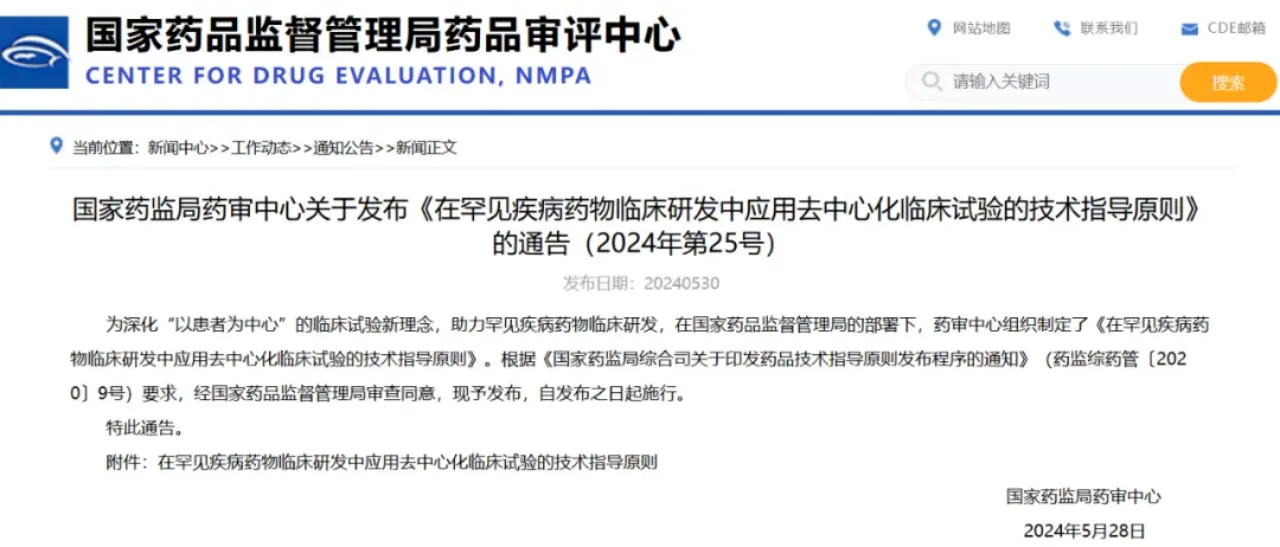
At the end of May, CDE issued the "Technical Guidance on the Application of Decentralized Clinical Trials in Clinical Development of Rare Disease Drugs" (hereinafter referred to as the "Guidance"), explicitly deepening the new "patient-centric" clinical trial concept to support the clinical development of rare disease drugs.
Why Promote DCT in Rare Diseases?
Currently, clinical development of rare disease drugs faces numerous challenges: small patient populations exacerbate recruitment difficulties; trial procedures are complex, visit modalities are diverse, clinical trial durations are long, and endpoints are complex, among other issues.
In addition, some patients with rare diseases have severe symptoms and limited mobility, which restricts their willingness and ability to travel to a study site. Therefore, exploring new models that better facilitate patient participation will help improve the efficiency of rare disease drug development.
Decentralized Clinical Trials
(DCT) are clinical trials in which some or all trial-related activities are conducted at locations outside traditional clinical trial sites through telemedicine and mobile/local healthcare.
Through fully remote or hybrid models, combined with digital health technologies (DHT), DCTs can provide more flexible and accessible new approaches and pathways for clinical trials of drugs for rare diseases.
1. Achieving Patient-Centricity
"Patient-centricity is an important principle in the design and implementation of DCTs."
In addition to following
the basic principles of GCP, the Guidelines specify that the basic principles for conducting DCTs for rare disease drugs include: patient-centricity, fitness for purpose, and risk-based quality management.
Among these, patient-centricity is
an important principle in the design and implementation of DCTs, specifying:
1. Understand the difficulties and pain points that specific patient populations face when participating in drug clinical trials, and design and implement DCTs with the goal of addressing those difficulties and pain points.
2. Fully consider the needs of trial participants, and do not change necessary "centralized" processes/operations to "decentralized" ones to reduce operational difficulty or at the expense of clinical trial quality.
3. Do not increase inequality in opportunities to participate in clinical trials; for trial participants who do not have the corresponding devices or whose devices do not meet performance requirements, the sponsor should provide necessary devices, etc.
II. Recommendations for DCT Application
"Using DHT to conduct patient-centric DCTs and promoting its application in rare disease research will help patients participate in drug clinical trials more conveniently."
The "Guidance" states that, taking into account the characteristics of rare diseases, it provides recommendations on how to apply
DCT in the clinical development of rare disease drugs:
1. Consider the actual circumstances and needs of rare disease trial participants, and select appropriate DHT that must be clinically validated to ensure its safety and effectiveness.
2. Before using DHT, the sponsor must validate the computerized systems involved in the clinical study and maintain an audit trail for initial data entry and any subsequent changes.
3. It should be ensured that data security safeguards are in place, along with the traceability of patient data and the consistency of data collected across different devices or technology platforms.
By applying
DHT, large volumes of clinical trial data can be collected in a timely and continuous manner in clinical trials of drugs for rare diseases, thereby helping to adopt adaptive trial designs, increase design flexibility, shorten trial duration, and improve study efficiency.
III. Encouraging the use of eCOA
"The application/development of eCOA is encouraged early in drug development, with timely and appropriate continuation into subsequent clinical studies and pivotal registration studies."
The "Guiding Principles" note in
DCT application scenarios that remote electronic clinical outcome assessment (eCOA) for clinical trial endpoints in rare disease drugs is an important component of DCTs for rare disease drugs.
Through
measurement achieved via methods such as DHT, eCOA tools can provide real-time data collection and monitoring, reduce data recording errors and underreporting, and improve data quality and integrity. Applying/developing eCOA early in drug development is encouraged, as is extending it in a timely and appropriate manner to subsequent clinical studies and pivotal registration studies.
EClinCloud: Patient-Centered Integrated eCOA Services
EClinCloud provides professional integrated services, including scale due diligence, usage rights acquisition, translation validation, scale digitization (eCOA), rater training, and more, and can provide assistance throughout the full clinical trial lifecycle centered on the study protocol.
In addition, EClinCloud is staffed with a senior medical team and experienced project managers to provide end-to-end support, delivering comprehensive, high-quality services tailored to the needs of sponsors/CROs, offering efficient solutions for smooth study initiation and conduct, and increasing the success rate of clinical R&D.