"Expert Consensus on Decentralized Clinical Trials" Officially Released
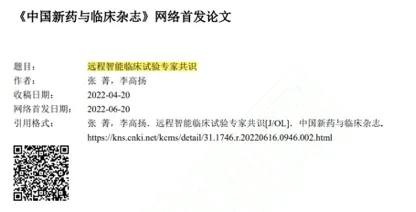
EClinCloud CEO Dr. Qin Long, as a member of the expert panel, participated in drafting the "Expert Consensus on Decentralized Clinical Trials," which was officially published online first on 6/20/2022.
n "Expert Consensus on Decentralized Clinical Trials"
Drafting Expert Group of the "Expert Consensus on Decentralized & Digitalized Clinical Trials," Special Committee on Drug Clinical Research of the Shanghai Pharmaceutical Association, and Drug Information Association China Digital Health Community.
Remote intelligent clinical trials (decentralized & digitalized clinical trials, DCT) are a new type of clinical trial conducted under a "participant-centric" philosophy, not limited to centralized site visits (decentralized), and supported by innovative technologies such as digitalization (digitalized). The application of DCT can not only reduce clinical trial costs, shorten trial timelines, and ease participant burden, but also improve participant representativeness, overcome traditional constraints on participant visit frequency to obtain broader scientific data, and reduce errors from human intervention and data conversion, thereby improving clinical trial quality. Practical cases related to DCT already exist both in China and internationally, and various countries have established corresponding requirements for DCT implementation; however, the diversity of fields involved in DCT and the operational complexity of new technologies may pose challenges to the consistency of clinical trial evaluation standards, data integrity, comparability of results, and operational standardization[1-3]. To further promote the application of DCT in China and provide a reference for its implementation and regulation, the Special Committee on Drug Clinical Research of the Shanghai Pharmaceutical Association, together with the Drug Information Association (DIA) China Digital Health Community (DHC) and experts from drug regulatory authorities, industry associations, research institutions, sponsors, and contract research organizations, building on the original 2020 edition of the "Expert Consensus on Intelligent Clinical Research" and drawing on recent practical experience across the industry, has developed an expert consensus covering DCT design and management, implementation, technology, and regulation as a reference for all parties involved in clinical R&D.
n Overview of the Expert Consensus
1. DCT Design and Management
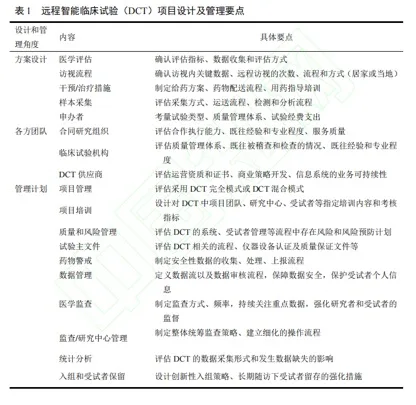
DCT centers on the rights and interests of trial participants, thoroughly evaluating the scientific validity and feasibility of each step based on the drug's clinical development pathway and clinical trial type to enable the smooth conduct of a DCT. At the same time, validation of computerized electronic systems spans the entire clinical trial lifecycle; validation should be conducted in a standardized manner during stages such as planning, testing, and summary, and validation records should be retained. In addition, given the flexibility of DCT design, thorough communication with regulatory authorities is recommended before and during the trial. Key points for DCT design and management are shown in Table 1.
2. DCT Implementation
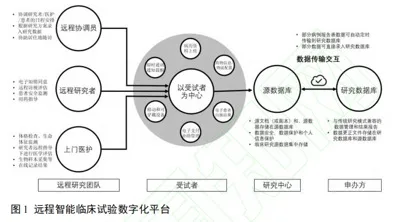
Compared with traditional clinical trials, which center on medical institutions, DCT implementation centers on trial participants and requires establishing a remote research team. Because research teams and trial participants use more smart tools, it is necessary to establish a source database capable of managing and storing data from both inside and outside the study site, and to ensure transmission and interaction between the source database and the study database. DCT implementation is supported by digital technologies and may adopt a fully remote model or a hybrid model combining remote and on-site visits. The digital platform for DCT is shown in Figure 1.
1. Intelligent recruitment and screening of trial participants
2. Electronic informed consent
3. Electronic source data capture, storage, and export
4. Remote visits and home-based follow-up
5. Direct-to-patient (DTP) delivery of investigational products
6. Remote monitoring
7. Biological sample collection and laboratory testing
8. Statistical analysis
9. Electronic payment/electronic stipends for trial participants
III. Application of Digital Technologies
DCT digital technology applications should be based on GCP requirements—such as protecting trial participant safety and ensuring data integrity—to provide convenience for trial participants and all trial stakeholders, and ultimately improve clinical trial efficiency.
The main digital technologies involved in DCTs include:
1. Telemedicine/internet-based healthcare
2. Wearable devices
3. Interactive visual analytics
4. Process automation
5. Cloud computing
6. AI
IV. Regulatory Considerations for DCT Practice in China
DCTs share the same regulatory requirements as traditional clinical trials: first, all regulations and regulatory requirements must be followed, and it must be assessed whether the rights and safety of trial participants and the authenticity, reliability, and scientific validity of data and results can be ensured after adopting remote and digital technologies.
• Regulatory considerations
• Responsibilities of all parties
Conclusion
DCTs, as they emerge and develop, will inevitably change or expand the concept of the "trial site" (the location where clinical trial-related activities are conducted), and future clinical trials are likely to take place across a combination of multiple spaces. Provisions of GCP formulated based on prior practice are likely unable to cover the changing scenarios brought about by the growing application of innovative technologies, and changes in practice will drive changes in standards. As the two core tenets of GCP, protecting the rights and safety of trial participants and ensuring the authenticity, reliability, and scientific validity of data and results need to be put into practice through more open and diverse models in the new era; all participating parties must both embrace change and proceed with prudence. The entry into force of the Personal Information Protection Law of the People's Republic of China in 11/2021 has provided a legal basis for the protection and management of trial participants' personal information during DCT implementation, and going forward, this consensus expert group will also closely follow the issuance of regulations and guidelines to make further updates and improvements. We believe that with regulatory policy support, growing acceptance of new models, and the continuous accumulation of pilot project experience, China's clinical trials are also expected to build a new clinical trial ecosystem that is participant-centered, integrates trials with medical care, features high-quality methodological design, maximizes usable data, and improves human health[13], helping clinical trials complete their digital transformation and upgrading.
Press and hold to scan the QR code to view the full version of the "Expert Consensus on Intelligent Clinical Research."

About EClinCloud
EClinCloud provides an integrated, all-in-one cloud platform (including solutions such as CTMS, eTMF, EDC, RTSM, and eCOA, as well as consulting services such as scale management, linguistic validation, rater training, study build and configuration, and data quality analysis) and clinical trial endpoint assessment technologies across therapeutic areas (including oncology, neurology, cardiology, pulmonology, dermatology, and others), combining cutting-edge technology with life data to build a globally leading "patient-centric" clinical evidence support SaaS cloud platform that helps domestic and international pharmaceutical companies and research institutions improve R&D efficiency, accelerate the market launch of drugs/devices, and benefit countless patients.